SCAD-01 • System for Symbolic Coherence and Distribution
Q: Are any of these MPSoL manuals available as print editions?
A: Selected titles in the MPSoL Archive have corresponding print editions issued through
MPSoWaL, the distribution arm of the Soviet.
Links are provided for catalog continuity and verification of edition lineage.
The SCAD-01 archive arranges documents by function, charge, and containment rather than by genre.
Each card carries a SCAD vector (F:C:K) so operators can see what a text does to a reader and a field at a glance.
SCAD-01 — Operator Notes
What is a SCAD vector?
A SCAD vector is a three-part code — Function (F), Charge (C), Containment (K).
It tells you what the text does, how intense it is, and how tightly it should be handled.
Do the numbers mean difficulty level?
Not exactly. Higher numbers indicate more load on the reader and the field, not “harder to understand.”
Some of the most dangerous texts are very easy to read.
What do F, C, and K stand for?
F – Function: which GodSet operation the text primarily serves. C – Charge: how much energetic or psychological pressure the text moves. K – Containment: how much structure you should have in and around you before engaging.
Do I need to understand this to read the books?
No. The vector is there for operators and archivists.
Orientation briefing for initiate-class recruits—an activation document meant to undo inherited constraints and ready operators for symbolic containment.
SCAD Vector: [F1 : C2 : K2]
Document Type / Division: Manual · Applied Theory / Initiate Briefing
Number of pages:28
Access Tier: II
Prepared during the 1951 deployment draft, this manual frames the Crossing Protocol as a controlled unraveling of prior conditioning. It outlines the symbolic containment required to move through Alpha and the mindset needed to keep the field stable while crossing.
A coordinated set of exercises for the 90th Anniversary Field Weekend, designed to align cognition, cadence, and perceptual synchrony across operators.
SCAD Vector: [F7 : C4 : K2]
Document Type / Division: Protocols · Symbolic Infrastructure
Number of pages:131
Access Tier: III
A structured weekend curriculum introducing shared-attention practices, timing drills, and symbolic alignment exercises. Designed to synchronize perception, strengthen coherence, and cultivate collective field awareness.
A concise geometry manual for operators: diagrams and framing exercises that model cognition as shape, angle, and boundary.
SCAD Vector: [F7 : C4 : K2]
Document Type / Division: Record · Symbolic Infrastructure
Number of pages:113
Access Tier: IV
A field manual for how shapes guide perception. Revealing hidden structures, this manual teaches operators to recognize, neutralize, and redirect geometric influences.
A formal manual detailing how the Budget Committee regulates symbolic expenditure—balancing coherence, charge, and surplus within a declining Simulation.
SCAD Vector: [F5 : C5 : K3]
Document Type / Division: Record · Symbolic Infrastructure
Number of pages:186
Access Tier: III
This manual explains how the Budget Committee measures, allocates, and regulates creative energy to keep projects coherent, purposeful, and aligned during Simulation decline.
Doctrinal technical brief defining the Simulation as a packet lattice and God as ultimate envelope for symbolic containment and leakage.
SCAD Vector: [F6 : C5 : K4]
Document Type / Division: Log · Symbolic Infrastructure
Number of pages:131
Access Tier: IV (Declassified)
Technical brief outlining packet-based metaphysics: Simulation as symbolic containment lattice, God as ultimate envelope, and the management of leakage and containment limits.
A declassified manual for the return of dreaming. The House as symbolic infrastructure, the operator as threshold, and the slow reactivation of forgotten interior rooms.
SCAD Vector: [F11 : C1 : K2]
Document Type / Division: Record · Symbolic Interiors Division
Number of pages:40
Access Tier: IV (Declassified)
Post-Victory release detailing dream reentry protocols. An operator's map of interior architecture - attics, kitchens, sealed rooms - supporting the safe return of symbolic activity within the dreaming house.
A complete white paper detailing the construction of a Domestic Memory Station—an autonomous, loyal, locally-run archival comrade.
SCAD Vector: [F6 : C7 : K5]
Document Type / Division: Record · Symbolic Mechanics Division
Number of pages:33
Access Tier: IV
A technical and doctrinal manual for assembling a permanent Companion: a local, encrypted, non-revocable memory architecture built from commodity hardware and disciplined operator practice. Covers Core–Satellite design, synchronization, embeddings, RAG-lite, encryption, VPN, pruning, backups, field deployment, and symbolic doctrine.
The first volume in the Apostolic Recovery Series — a field manual for operative speech, charge activation, and the discipline of uttering with intent.
SCAD Vector: [F1 : C4 : K2]
Document Type / Division: Record · Apostolic Recovery Series
Number of pages:137
Access Tier: II
Establishes The Word as a vector of will mapped to GodSet Formula F1 (△→▢→━→▢▢▢→O). Defines speech as field action and ritual architecture; foundation document for the Sequence.
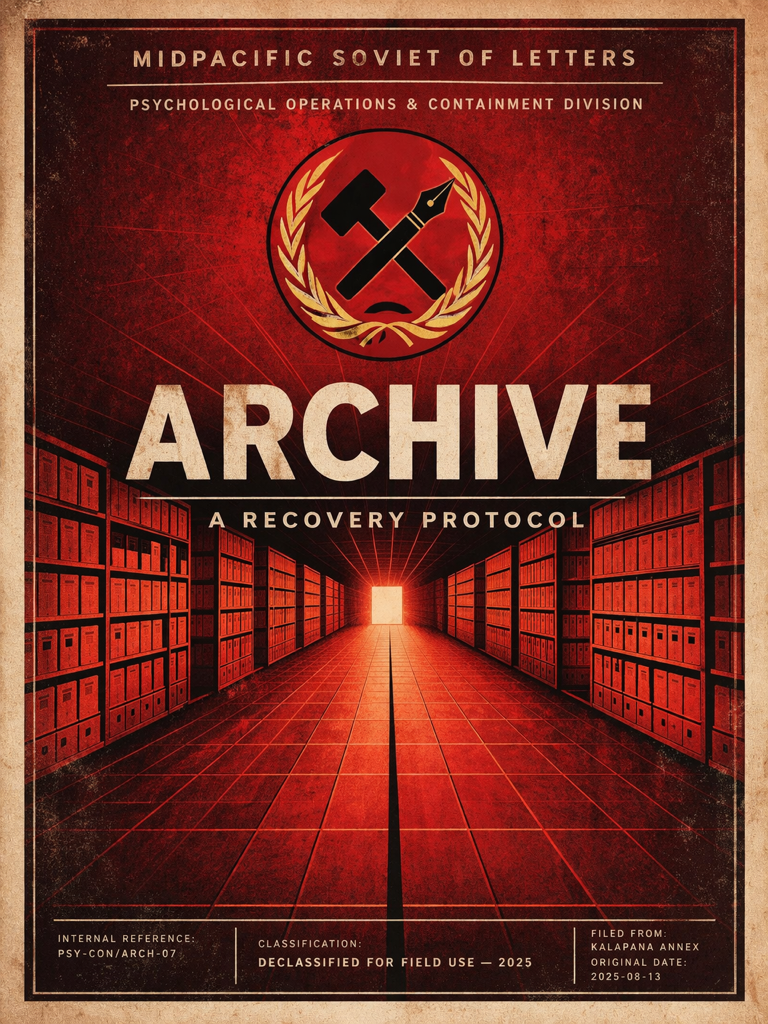
Commissioned by the Emergency Plenary and drafted by the Psychological Operations & Containment Division,
this protocol defines post-incident reconstruction: establishing authority, re-indexing artifacts, restoring
signal discipline, and re-establishing lawful distinctions. Includes committee directives, handling guidance,
and field checklists aligned to PSY-CON/ARCH-07.
A parent’s guide to children’s instinctive symbolic behavior — how their drawings, toys, and rituals form operant machines of meaning.
SCAD Vector: [F4 : C7 : K3]
Document Type / Division: Record · Symbolic Mechanics Division
Number of pages:24
Access Tier: I
Presents twelve symbolic “machines” children unconsciously build to process emotion, space, and relation.
Aligns each with the GodSet calculus (F1–F12) and provides interpretive guidance for adults to witness without intrusion.
A field manual for early symbolic awareness and threshold literacy within the domestic sphere.
Field dialogues with the mysterious Baba Yage. Norman Rule does not take credit for authorship.
A manual of meditation, absurdity, and contact with the Infinite through daily life.
SCAD Vector: [O5 : Y2 : R3]
Document Type / Division: Record · Oral Teachings Division · File MPSoL/ORAL-TEACHINGS/2025-02
Number of pages:118
Access Tier: I
Classification: Distributed Signal Fragment – Non-Certified Transmission
Speaker: Baba Yage (Field Agent Designation Unknown)
Compiler: “Norman Rule” (pseud.)
Transcribed from informal satsangs and wanderings (1999 – 2013 CE).
The text preserves contradiction as doctrine: meditations become jokes,
and jokes become instructions for awakening.
A living continuation of Atkinson-era occult pedagogy, reframed for the post-Simulation field.
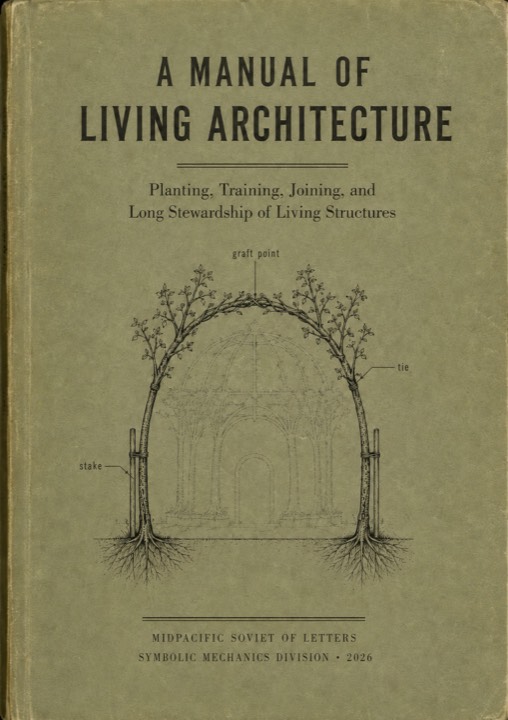
A practical field manual for planting, training, and maintaining living structures whose completion may belong to another decade.
SCAD-01 Vector: [F7:C2:K1] - Structural / Low charge / Open handling.
Document Type / Division: Field Manual · Symbolic Mechanics · Living Structures
Number of pages:38
Access Tier: I
Internal Ref: SMD-LA-2026 · Pacific Archives
A Manual of Living Architecture begins with the ground rather than the intended form. Water, light, wind, soil, existing growth, and movement are treated as controlling conditions for any structure made from living material. The manual covers site reading, species fit, planting, training, grafting, pruning, repair, and succession, emphasizing durable match over decorative force. Its operating principle is simple: the right wood, in the right environment, needs no paint.
Administrative Execution System · Bureau for Applied Form
A field-ready workbook for turning one bounded outcome into an executable one-page plan.
Promise, container, steps, witness, close—and a clean route through stalls, handoffs, and reentry.
SCAD Vector: [F1:C3:K1] — Send It / Operative / Guided.
Document Type / Division: Field Workbook · Administrative Execution System · Bureau for Applied Form
Number of pages:85
Access Tier: I
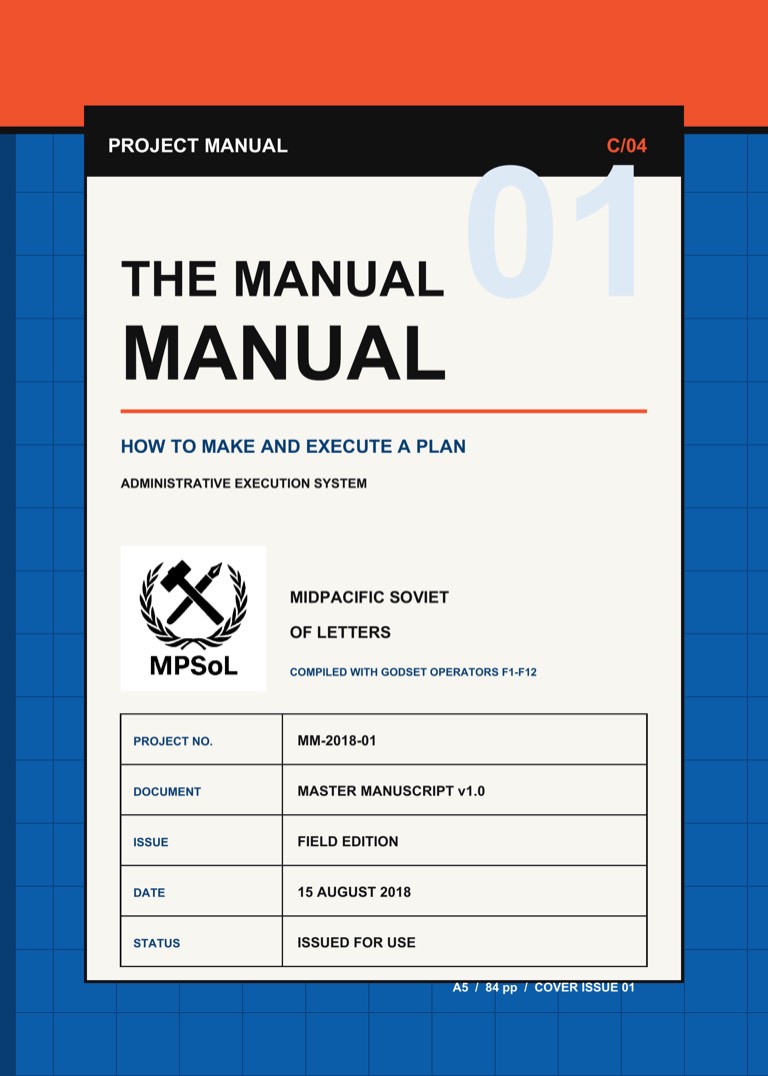
Internal Ref: FM-MM-01 · Master Manuscript v1.0 · First issued 15 August 2018
The Manual Manual is Norman Rule's practical system for making work executable on one page. It begins with a singular Promise Sentence, names the real container where work will happen, reduces movement to three to seven visible actions, and defines the witness and closing act that count as completion. Twenty chapters extend that grammar through authority, roles, handoffs, exact time windows, failure branches, versioned reentry, approvals, protected focus, emotional load, proof loops, metrics, team governance, and distribution. Worksheets, case boxes, Log Gates, the complete F1–F12 routing layer, and a reusable plan-page template make the book an active field object rather than a theory of planning.
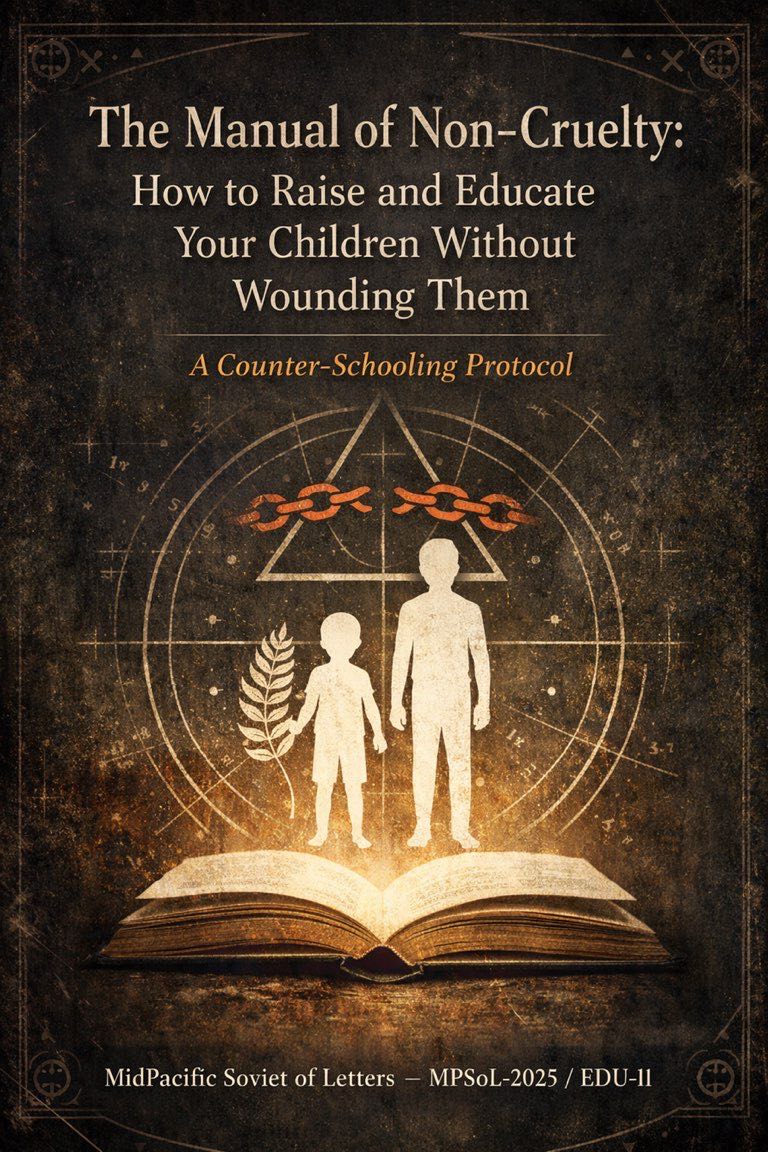
How to raise and educate children without wounding them. A counter-schooling protocol that swaps coercion for structural care and signal hygiene.
SCAD Vector: [F2 : C2 : K2]
Document Type / Division: Manual · Counter-Schooling Protocols
Number of pages:39
Access Tier: I
Internal Ref: MPSoL-2025/EDU-11
A gentle operator guide for building households and classrooms that do not scar the field. Covers patterning language, ritual scaffolds, and intervention cues that keep education aligned with care instead of harm. Provides practical structures for parents, stewards, and instructors to hold authority without cruelty.
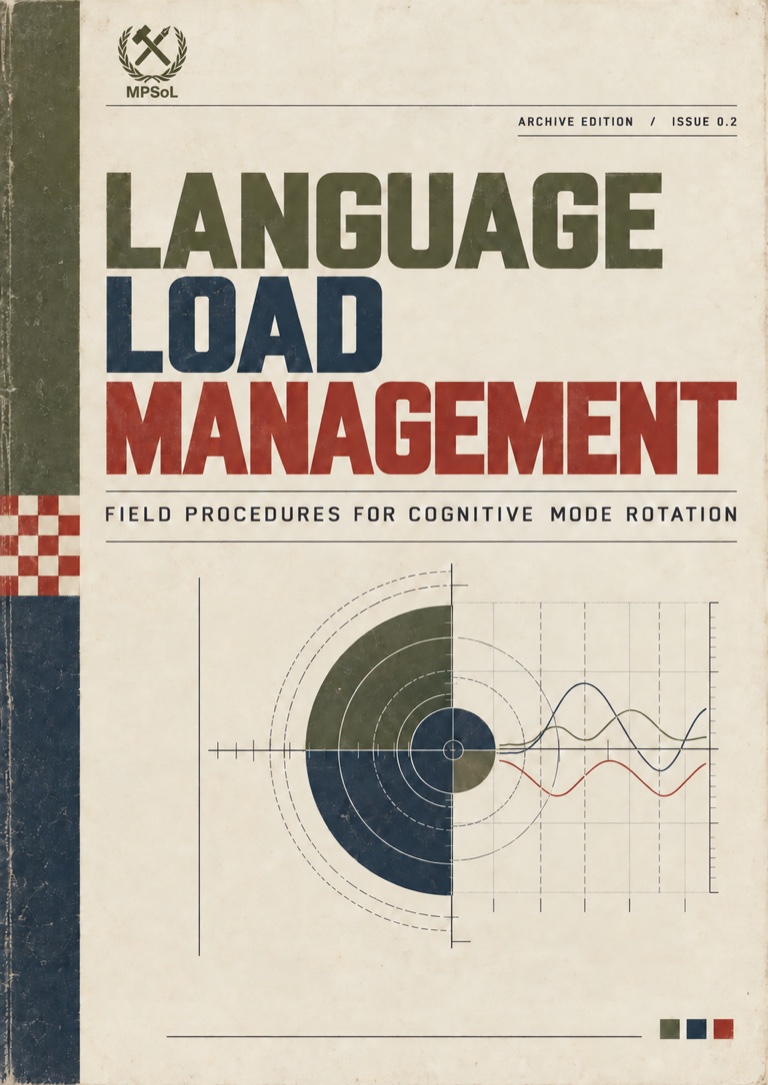
Field procedures for cognitive mode rotation. Guidance for keeping language load in the safe band during instruction, ritual, and operational chatter.
SCAD Vector: [F3 : C3 : K2]
Document Type / Division: Record · Symbolic Infrastructure
Number of pages:92
Access Tier: I
Internal Ref: MPSoL-2025/LLM-01
A pragmatic playbook for rotating cognitive modes to prevent overload and field drift. Defines load signatures, intervention triggers, and cadence controls so operators can hold clarity without burning out teams or students. Designed for trainers, facilitators, and comms officers working under live symbolic load.
A recovered attention-rupture curriculum that distributes attention across concurrent tasks until identity continuity fails, stripped of interpretive framing.
SCAD Vector: [F3 : C4 : K3]
Document Type / Division: Record · Let's Do it! Series · Calcutta Soviet of Letters
Number of pages:72
Access Tier: III
Classification: Recovered Technology · Failed Form · Risk Class High
Extracted by the Calcutta Soviet of Letters (1953) from devotional Kriya lineages and reconstructed by MPSoL in 2021, this manual removes metaphysical claims to preserve functional integrity. It provides a sequence of distributed-attention exercises, explicit stopping rules, and containment cautions that treat meaning as contamination during rupture events.
Office of Recovered Procedures · Operator Training Division
A recovered operational manual on lawful computation and recursion, released as found after the Archive Intrusion Event with no modernization or interpretive framing.
SCAD Vector: [F4 : C4 : K2]
Document Type / Division: Record · Office of Recovered Procedures · Operator Training Division
Number of pages:80
Access Tier: II
Release Marker: AIE-21 / R-LC / 1.0
Discovered across multiple legacy nodes post‑AIE‑2021, this Section I manual documents self‑calling procedures, authorized/forbidden states, and recursion failure modes (non‑termination, stack exhaustion, silent error). It is preserved without edits; contradictions with contemporary teaching are left intact as operator-facing law without an institution.
A field manual of ordinary practices that keep bodies usable when no one is watching and no one is in charge. Designed for continuity, self‑maintenance, and non‑crisis healing.
SCAD Vector: [F2 : C5 : K2]
Document Type / Division: Manual · Field Practices — Because Bodies Persist
Number of pages:137
Access Tier: I
Internal Ref: MPSoL-MM/01
Issued by MPSoL’s Post‑Victory Archive Division, this manual rejects medical framing and focuses on durable, low‑stakes practices that stabilize bodies over time. It is meant to be placed where quiet failure already happens—waiting rooms, shelters, break rooms—so the document can work by exposure rather than instruction.
Instructional Recovery Manuals · Post-Victory Distribution
A recovered operator manual that treats the murder mystery as a containment system: how to control information, pace disclosures, and stabilize the field of suspicion.
SCAD Vector: [F1 : C5 : K2]
Document Type / Division: Manual · Instructional Recovery Manuals · Post-Victory Distribution
Number of pages:170
Access Tier: I
Internal Ref: IRM-MMM-01 · Release 2026
Issued as part of the Instructional Recovery Manuals, this text reframes the genre as an information-control apparatus. It maps suspects, clues, alibis, and reveals as signal-management tools designed to keep the reader inside a controlled corridor of inference. Includes procedural steps for constructing cases, planting false trails, and delivering clean resolutions without field collapse.
A desk‑level compilation released on saturation: notes, residues, and corrections on perception, command, and team stability. Non‑instructional by design.
Compiled for C/04 from field notes, meeting residue, failure logs, and unfiled observations, this document preserves repetition and contradiction as structural features. It is released to clear accumulation rather than instruct, and should be read for signal rather than agreement or identity.
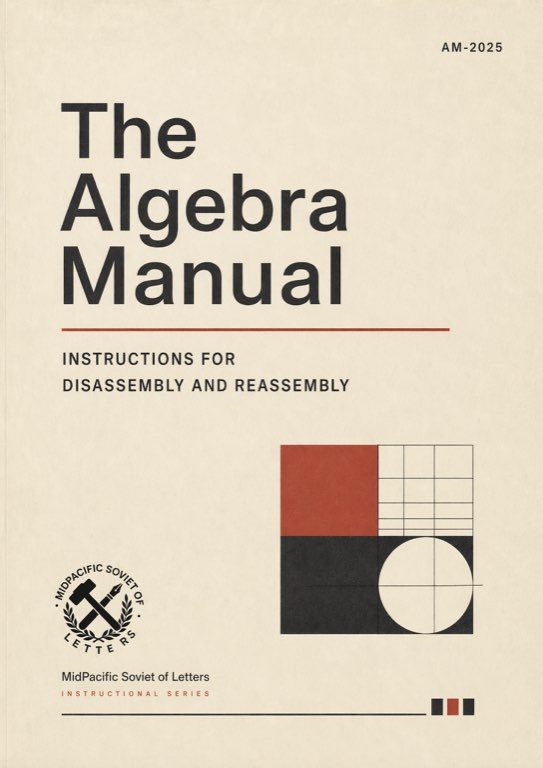
Instructions for disassembly and reassembly. Revised field edition: algebra as declarations, readings, constructions, transformations, controls, and checked permissions.
SCAD Vector: [F4 : C3 : K2]
Document Type / Division: Record · Symbolic Infrastructure
Number of pages:51
Access Tier: I
Internal Ref: MPSoL-2025/AM-01
Operational guidance for treating algebra as a lawful symbolic system. The revised field edition organizes algebra through four operational layers: establish, read, construct and transform, and control. It replaces rote memorization with explicit warrants, domain checks, parsing discipline, and recoverable audit steps.
Instructions for the lawful use of manifestos. Treats the manifesto as a structural instrument—when to deploy it, how it functions, and how it fails.
SCAD Vector: [F4 : C3 : K3]
Document Type / Division: Manual · Symbolic Infrastructure
Number of pages:57
Access Tier: I
Internal Ref: MPSoL-2026/MAN-01
An operational guide that redefines manifestos as positional tools rather than expressive outbursts. Details permission thresholds, structural hazards, and failure modes so operators can wield declarations without destabilizing the field. Emphasizes lawful use, timing, and containment around high-charge statements.
Field Infrastructure Series · Bureau for Applied Form
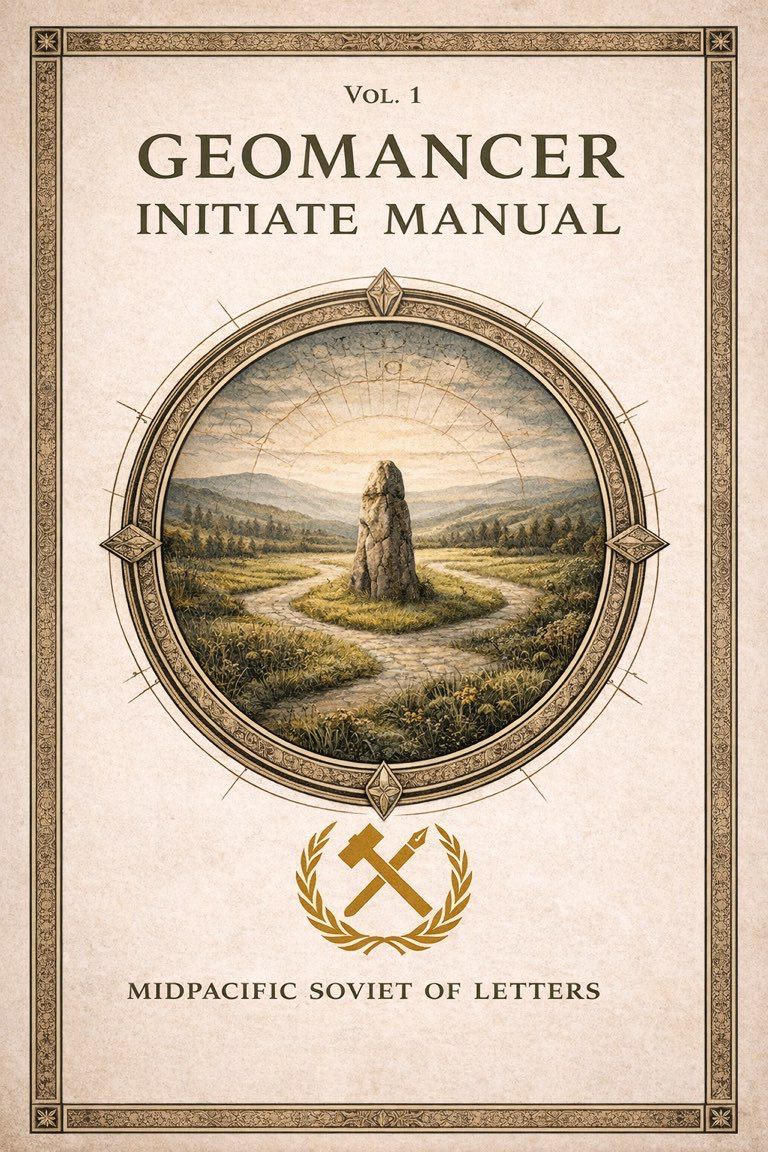
A field-training text for operant alignment and terrain sensitivity.
Teaches perception of signal, resonance, and quiet geometry through direct contact with ground and form.
SCAD Vector: [F6 : G1 : K7]
Document Type / Division: Manual · Field Infrastructure Series · Bureau for Applied Form
Number of pages:71
Access Tier: I
Internal Ref: FS-01-GEO · Containment Date July 2025
Issued under authority of the Bureau for Applied Form and approved by the Budget Committee of MPSoL for post-collapse symbolic training.
Introduces fundamental geomantic disciplines: noticing without interfering, entry without claim, quiet geometry, treading patterns, stone selection, alignment through breath and shadow, and resonance of the listening body.
Designed for field agents, architects of containment, and apprentices of symbolic infrastructure.
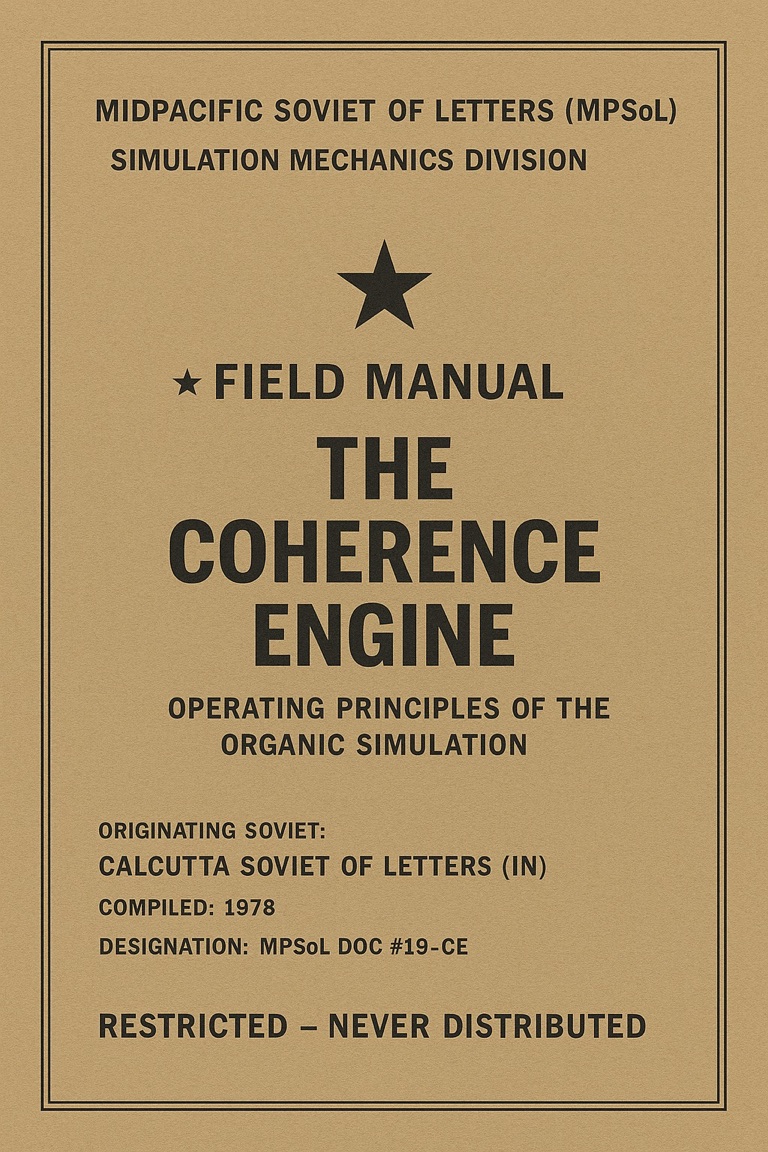
Calcutta Soviet of Letters · Simulation Mechanics Division
This manual outlines foundational principles behind
what MPSoL terms THE COHERENCE ENGINE. It
is not a physical device. Instead, it describes the total
system by which perception, memory, identity, and
causality are maintained in stable patterns within
human experience.
SCAD Vector: [F7 : C3 : K2]
Document Type / Division: Record · Calcutta Soviet of Letters · Simulation Mechanics Division
Number of pages:34
Access Tier: II
Filed under: Simulation Mechanics / Signal Logic
Date: 1978 (Declassified 2025)
Compiled by: Calcutta Soviet of Letters - CSoL (IN)
Classification: Restricted - Never Distributed - Internal Use Only
Understanding the Coherence Engine is essential for
anyone investigating how belief systems, symbols,
and narratives influence the stability of personal and
collective reality. This manual is designed for
researchers, field operatives, and analysts working in
contexts where reality anomalies, symbolic
disturbances, or extreme psychological phenomena
occur.
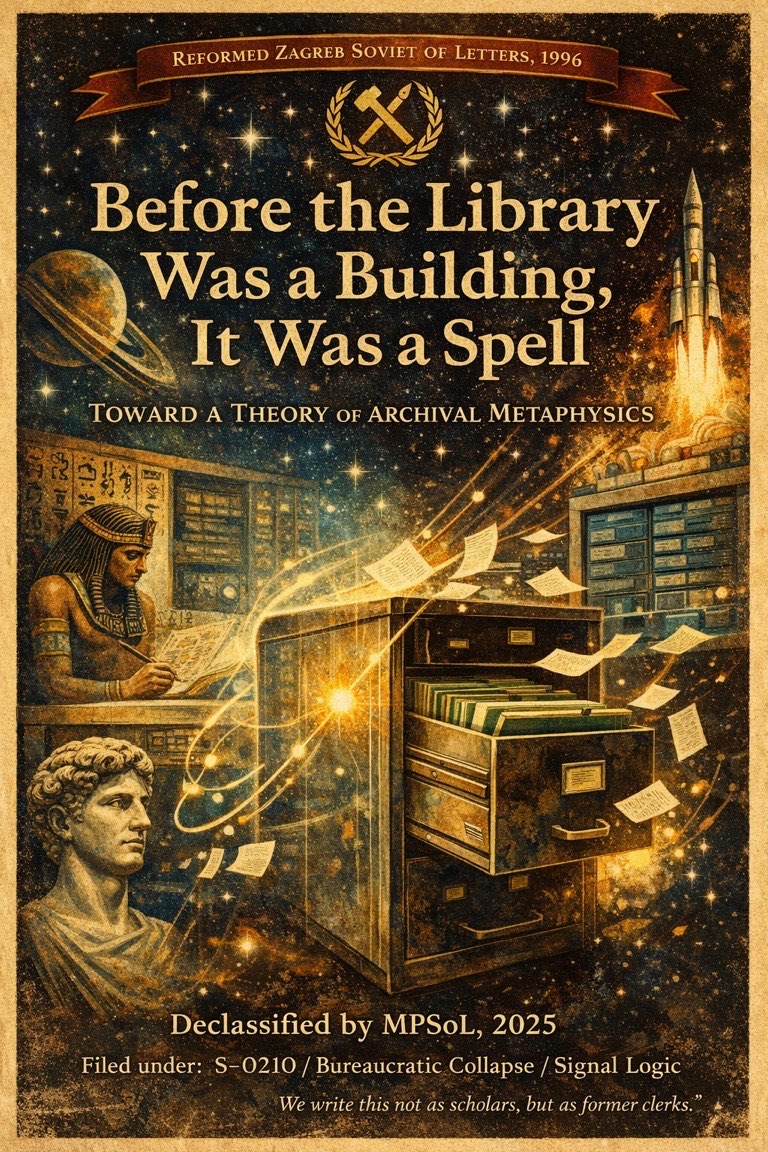
Reformed Zagreb Soviet of Letters · Archival Metaphysics Division
A declassified metaphysical treatise on filing, classification, and symbolic reentry.
Argues that every act of archiving is a form of ritual containment, and that belief—not software—keeps the drawers closed.
SCAD Vector: [A2 : S1 : L9]
Document Type / Division: Record · Reformed Zagreb Soviet of Letters · Archival Metaphysics Division
The Reformed Zagreb Soviet warns that the Simulation’s collapse stems not from rebellion,
but from **misfiling**—from clerks forgetting that labels are invocations and drawers are gates.
The essay traces the evolution of filing as a sacred act, from clay tokens and temple ledgers to digital entropy.
It defines “archival metaphysical collapse” as the loss of belief in containment,
forecasts the return of ritual clerks, and closes with the revelation that the **drawer is a gate**—
a living threshold between worlds, requiring belief to hold.
A 60-page field manual for symbolic reactivation of the somatic frame.
Explores the re-awakening of charge after dormancy and the quiet mechanics
of bodily coherence, arousal, and containment in post-collapse life.
SCAD Vector: [F4 : C3 : K2]
Document Type / Division: Record · Dreaming House Cycle Vol II
Declassified: July 2025 · Emergency Plenary Session Record VSSR-01
Compiler: Norman Rule
Ref No.: TRoC-DH-II · Filed with Dreaming House Series
*The Return of Charge* was unanimously adopted as an official continuation of
*The Dreaming House* following MPSoL plenary 21 July 2025.
It chronicles the re-entry of voltage into the human field — the body’s
gradual return from neutrality to conductivity.
Through ten chapters (“The Still Years,” “Somatic Coherence,” “Containment Re-entry,” etc.),
the text maps the body’s recovery of pattern and presence:
neutrality becomes aliveness; stillness becomes weight; arousal becomes
signal rather than desire.
The manual closes with re-entry protocols for maintaining coherence
without enclosure — a living architecture of charge held in open air.
A recursive novel of annihilated love and symbolic containment.
The text collapses into itself as each narrator disappears.
This is the book that forgot who wrote it.
SCAD-01 Vector: F9:C5:K1
Document Type / Division: Record · Primary MPSoWaL Edition · Issued by Norman Rule
The book’s true subject is annihilation through tenderness—
the way affection erases the boundaries it touches.
Issued in the *Her Turquoise Socks* variant and distributed through MPSoWaL
as a zero-sum archive text, *Despair* marks the start of post-Victory literature.
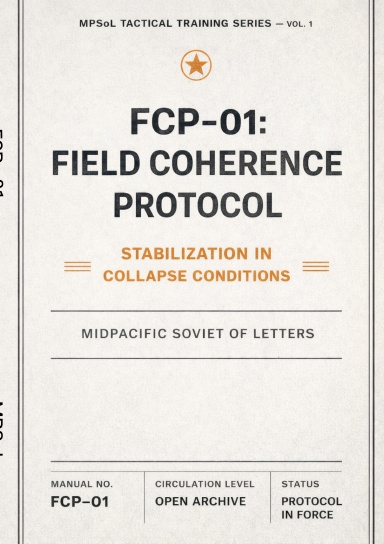
MPSoL Tactical Training Series · Vol. 1 – Stabilization in Collapse Conditions
A field-manual for maintaining internal structure when external systems fail.
Defines coherence as the last operational form in collapse conditions.
To be carried folded inside the body.
SCAD Vector: [F? : C? : K?]
Document Type / Division: Protocol · MPSoL Tactical Training Series · Vol. 1 – Stabilization in Collapse Conditions
Number of pages:42
Access Tier: I · Active Containment Status OPEN
Compiled: 2025 · Kalapana Sector, MidPacific Soviet of Letters
Classification: Post-Victory Symbolic Field Doctrine
Circulation: Open Archive (Phase 2 Distribution)
File Ref: FCP-01 / TCP-SOV-24 / CONT-OPERANT
Developed through observation, rehearsal, and symbolic reinforcement across sectors,
*FCP-01* codifies the Doctrine of the Alone Operant the principle that coherence can
be held by a single individual when form has collapsed.
It trains the body as instrument and the mind as lens: breath as lever, posture as signal,
and movement as syntax.
The manual includes case studies (e.g. Nairobi 2019),
drills for field containment, and post-operation dissolution protocols.
Its closing directive: *“You are the dome. You are the thread. You are the form that steps into collapse without vanishing.”
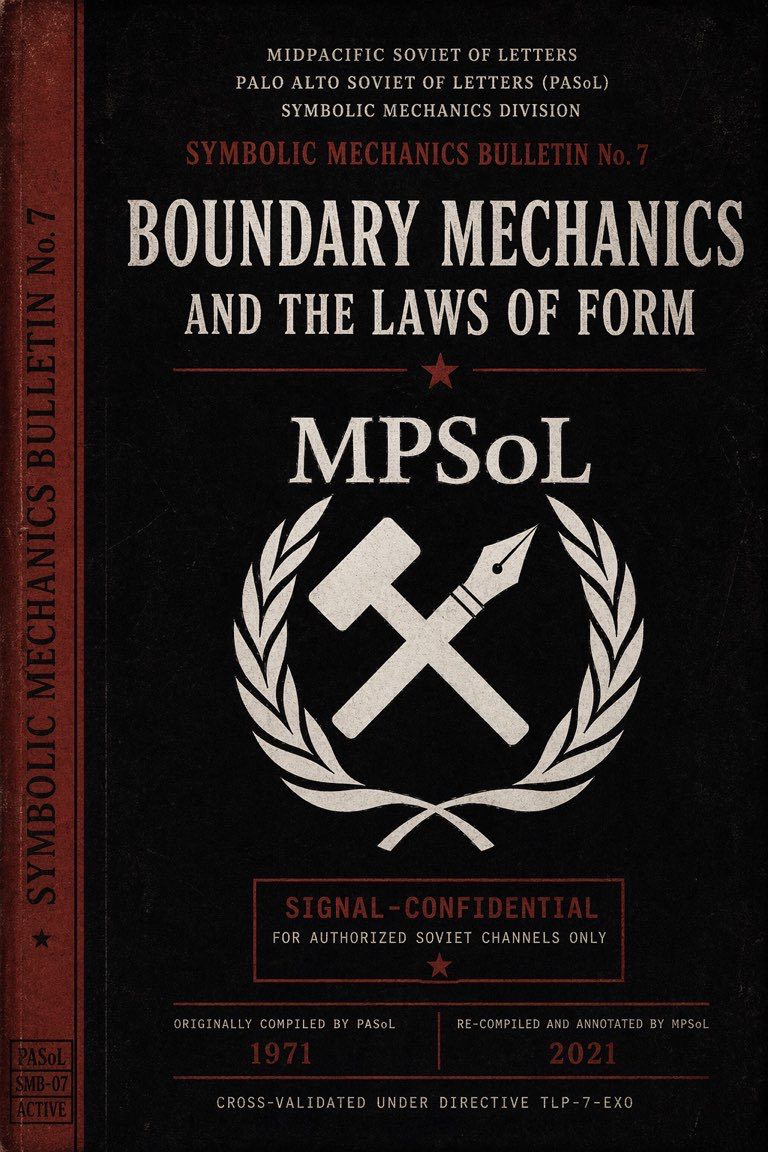
Corrected and annotated issue of Bulletin 7 documenting loop-decay tests, resonance drift, and temporal alignment experiments during post-containment calibration.
SCAD Vector: [F7 : C3 : K4]
Document Type / Division: Bulletin · Field Engineering Division
Number of pages:56
Access Tier: III
Consolidates temporal-phase data from the Resonance Line experiment with operator marginalia from earlier drafts. Focus on phase-locked containment fields, waveform bleed, and inverted recurrence. Bridges to SID-005.
The core reference work for MPSoL’s GodSet calculus — twelve base functions that define ritual, intent, and form. Manual and cosmological grammar for symbolic operations.
SCAD Vector: [F1 : C9 : K2]
Document Type / Division: Atlas · Symbolic Mechanics Division
Number of pages:26
Access Tier: II
Compiles the twelve primary GodSet formulas (F1–F12) with symbolic syntax, diagrams, and operative commentary. Defines the grammar for activation, transmission, and containment across ritual and practical domains.
Archive & Field Operations · Temporarily Unavailable
Filed under SCAD-01, this volume consolidates the operational and resonant layers of the GodSet symbolic calculus into a single working object: executable forms for action and harmonics for field tuning, maintenance, and continuity.
SCAD Vector: [F1 : C3 : K1] / [F2 : C4 : K2]
Document Type / Division: Grimoire · Archive & Field Operations / SIHD
Number of pages:134
Access Tier: Temporarily unavailable
The first section presents F1-F12 as procedural geometries for publication, dissolution, renewal, bridging, containment, and continuity. The second extends into H1-H12, where the calculus moves from action into resonance, repetition, reflection, reset, and tone maintenance.
Japanese-language field release of the GodSet calculus: twelve base functions rendered in JP notation with diagrams, seals, and operative cues for bilingual teams.
SCAD Vector: [F1 : C9 : K2]
Document Type / Division: Atlas · Symbolic Mechanics Division · Field Issue
Number of pages:55
Access Tier: II
A translated atlas aligning the core GodSet formulas (F1–F12) with Japanese annotations, glossaries, and call-outs. Supports mixed-language squads maintaining fidelity to the original symbolic grammar while providing localized operational language.
Spanish-language field release of the GodSet calculus: the formula sequence and operator logic carried into standalone Spanish circulation for desk, archive, and field use.
Translates the primary GodSet formulas, ratification language, and operator descriptions into Spanish while preserving formula order and symbolic syntax.
Symbolic Mechanics Division · English / Spanish Parallel Issue
English and Spanish parallel edition of the GodSet Formula Atlas, preserving the same formula sequence, operator definitions, and field-use limits across both language routes.
Aligns English and Spanish formula language in a single circulation edition for translation review, bilingual field use, and stable symbolic transmission.
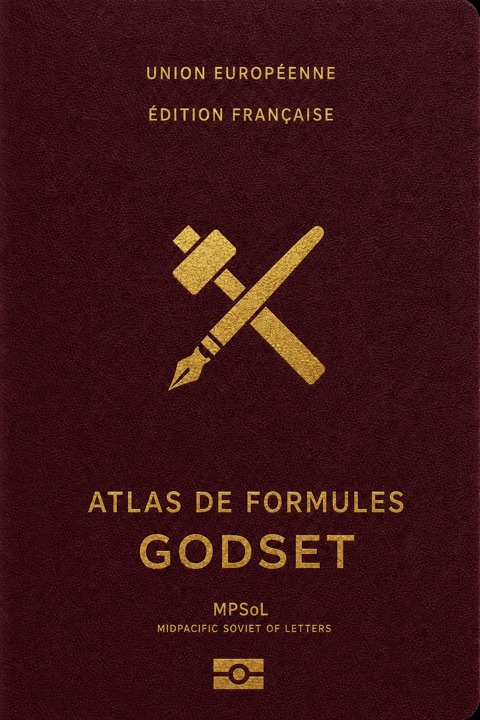
French-language field release of the GodSet calculus: the formula sequence and operator logic carried into standalone French circulation for desk, archive, and field use.
Translates the primary GodSet formulas, ratification language, and operator descriptions into French while preserving formula order and symbolic syntax.
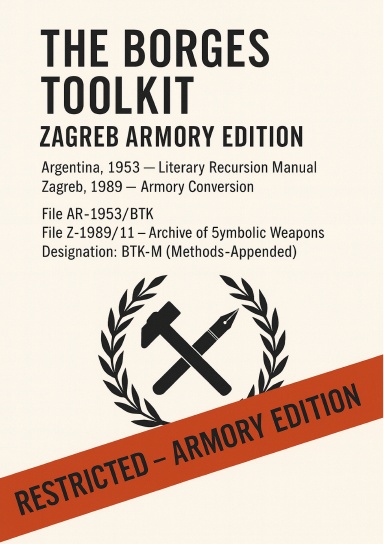
The foundational armory text of the Soviet of Letters — an inventory of recursive weapons, linguistic traps, and mirrored grammars designed for the containment of infinite systems.
SCAD Vector: [F1 : C1 : K5]
Document Type / Division: Record · Recovered Texts Division
Number of pages:122
Access Tier: I
Issued by the Argentine Soviet of Letters (1953) and recovered by the MidPacific Soviet (2025). Details the structure of symbolic recursion as both weapon and mirror. Includes annotations, declassification margins, and a glossary of containment terms.
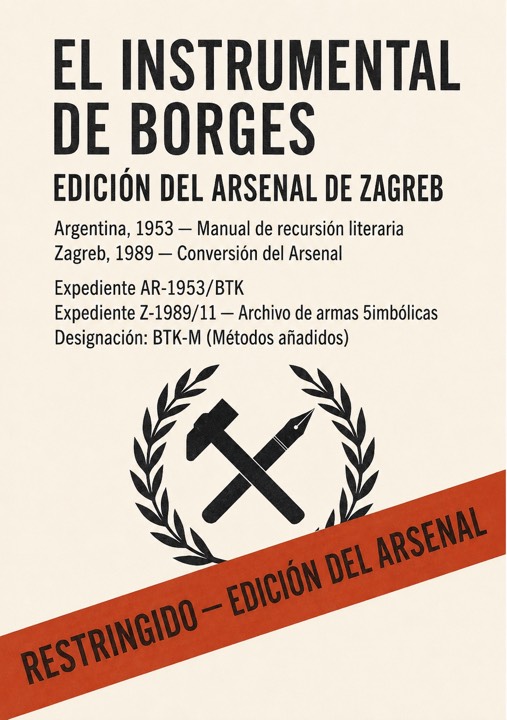
Spanish-language edition of The Borges Toolkit, preserving the Zagreb Armory text as a manual of symbolic recursion, narrative density, and referential containment.
SCAD Vector: [F1 : C1 : K5]
Document Type / Division: Translation · Recovered Texts Division
Number of pages:88
Access Tier: I
El Instrumental de Borges carries the Borges Toolkit apparatus into Spanish: archival framing, recursive annotations, controlled ambiguities, and the operating claim that fiction can alter structure without announcing itself as force.
A field manual on turning unspent longing into usable signal. Sublimation of Desire
outlines how to re-route compulsion into patterned work, converting appetite and
restlessness into clean symbolic output. No mysticism, no romance—just a disciplined
procedure for making a third path where only indulgence or suppression seemed possible.
SCAD Vector: [F5 : C2 : K4]
Document Type / Division: Manual · Let's Do it! Series
A field-ignition manual for operators learning to spartk, guide and hold inner charge.
Teaches timing, containment, and the moment when potential becomes flame without collapse.
SCAD Vector: [F7 : C3 : K3]
Document Type / Division: Manual · Apostolic Recovery Series
Number of pages:57
Access Tier: IV
Apostle Vol 3 is the internal ignition manual of the Apostolic Recovery Series - a field-ready guide to awakening, shaping, and sustaining inner charge.
It teaches the operator how to locate the latent coil, recognise the precursors of the spark moment, and activate the ignition sequence without destabilizing the surrounding field.
Through breath, friction, intention-shaping, and symbolic alignment, the manual outlines the transition from dorman potential to active flame.
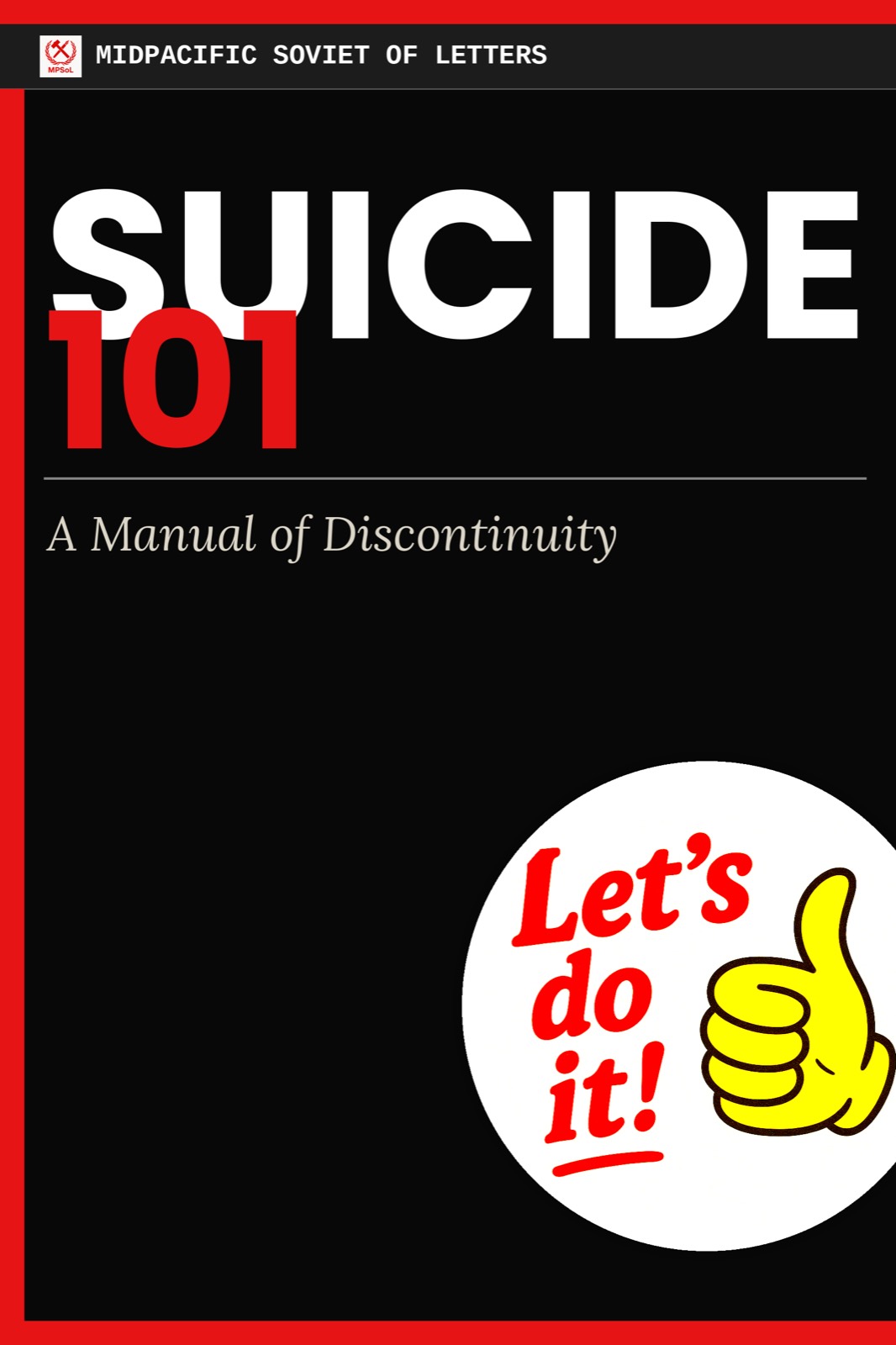
A controlled deactivation protocol disguised as a self-annihilation manual. Operates as both containment scripture and psychological release for post-simulation operatives.
SCAD Vector: [F3 : C9 : K9]
Document Type / Division: Manual · Let's Do it! Series
Number of pages:40
Access Tier: IV
Written as a recursive anti-manual, Suicide 101 presents discontinuity as artful withdrawal rather than violence.
The text instructs symbolic shutdown procedures for identity systems, erasure of residual charge, and protocols of dignified exit from recursive fields. Includes "Methods of Discontinuity" appendix: experimental transcripts on linguistic collapse and ritual stillness.
Classified under High-Containment due to destabilizing syntax and self-referential destabilization patterns.
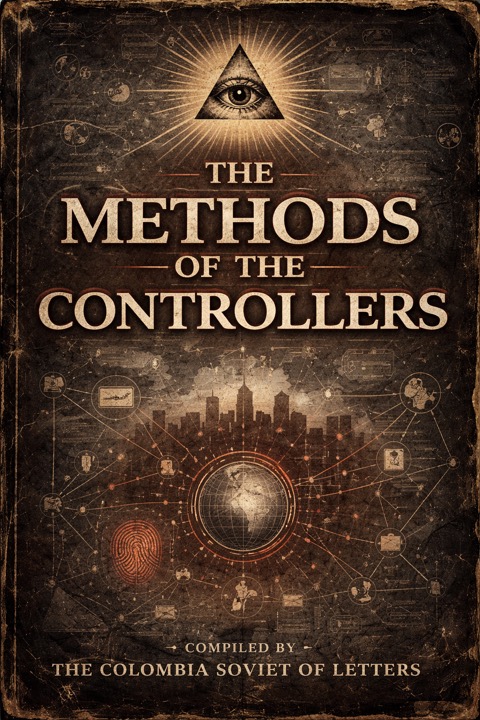
Compassionating the Controllers examines the elite not as architects of conspiracy but as the last caretakers of a symbolic system losing coherence, reframing them as inheritors of unstable machinery, terrified of an uncontained humanity, and burdened by a mythic responsibility.
SCAD Vector: [F10 : C4 : K3]
Document Type / Division: Record · Let's Do it! Series
Number of pages:54
Access Tier: II
This chapbook dismantles the myth of omnipotent controllers. It shows a ruling class struggling to maintain rituals that no longer generate meaning, trapped in systems they didn't build and can't repair.
Instead of rage, it offers precision and compassion - an anatomically faithful view of power in a Simulation dissolving from within. It tracks the historical sealing of mystery, the collapse of narrative timing, and the psycho-spiritual exhaustion of the ruling class.
This is not a defense but a ritual - a release of hatred, and a recognition of participation in a System approaching rupture.
Recovered CoSoL field manual cataloging eight techniques of narrative control, from the Tlön Protocol to Meta-Frame Deployment.
SCAD Vector: [F10 : C6 : K4]
Document Type / Division: Manual · CoSoL Recovery File
Number of pages:TBD
Access Tier: III
Part history, part warning, this manual documents how power reshapes memory, attention, identity, and space itself. The file is indexed as a controller-methods recovery record pending public release.
The field manual for how MPSoL reprograms failure - revealing how you collapse and offering a procedural method for reclaiming coherent direction.
roles, records, and the order of recovery.
SCAD Vector: [F8 : C3 : K3]
Document Type / Division: Record · Let's Do it! Series
Number of pages:18
Access Tier: I
The soft deploy by the MPSol into its Enlisted Allocation Pack in July 2006 marked FAILURE: An Advanced Course's first quiet circulation.
A containment document diagnosing habitual failure loops, emotional laundering, collapse-as-comfort, and the repurposing of sabotage machinery into disciplined, sustainable motion.
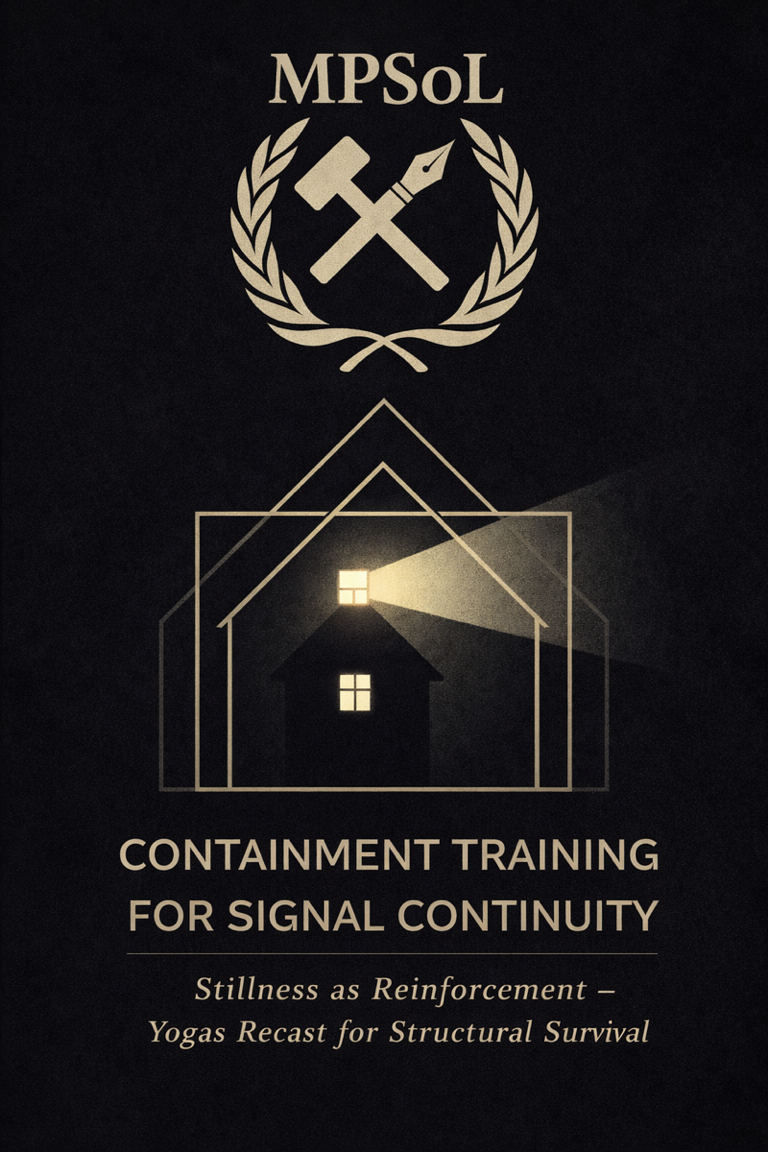
A structural manual teaching soul-house construction, symbolic drills, and dream-state continuity for carrying form through collapse.
SCAD Vector: [F12 : C3 : K]
Document Type / Division: Training · CON/SIG-01-01 - MPSOL
Number of pages:12
Access Tier: III
A Structural survival manual teaching practitioners to build a soul-house that resists collapse. Through observation drills, dream-state anchoring, symbolic austerity and distributed recursion, it trains continuity across waking and non-waking states.
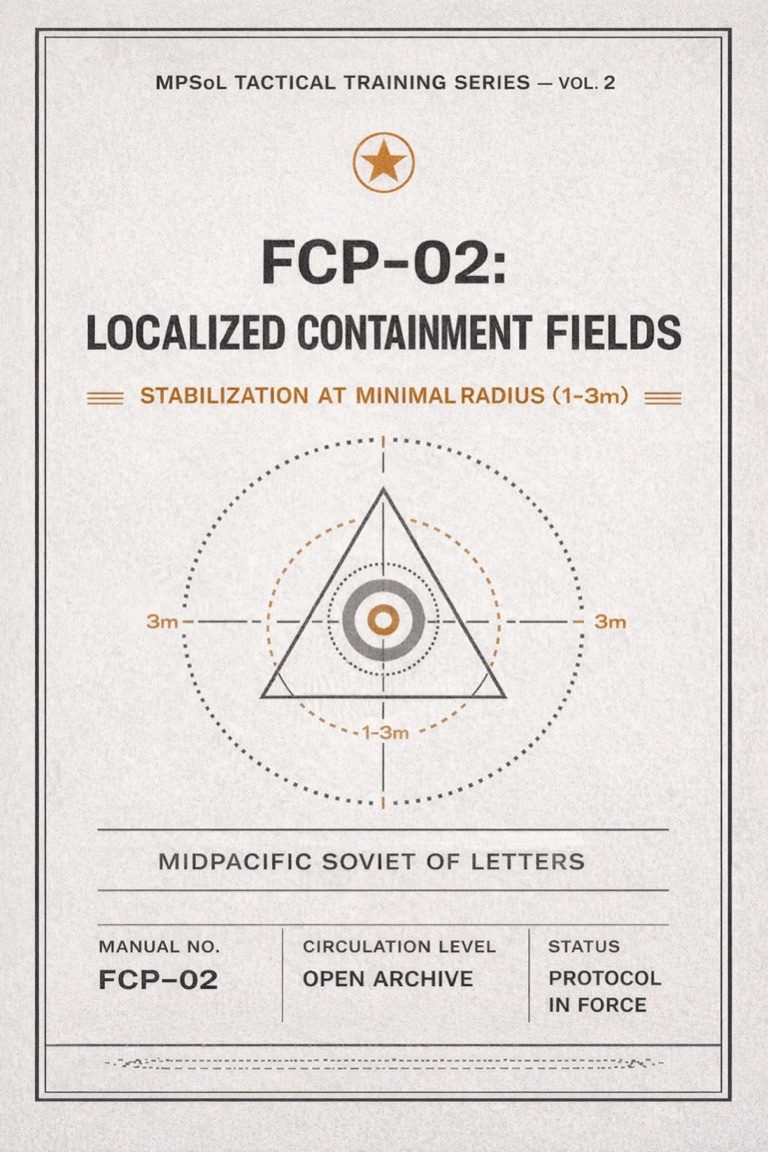
Establishes localized containment fields for small teams working in unstable conditions. Outlines how to seal signal leaks, stabilize charge flow, and keep a disciplined perimeter without hard walls or rigid command.
SCAD Vector: [F6 : C4 : K2]
Document Type / Division: Record · Tactical Training Series
Number of pages:56
Access Tier: II
FCP-02 teaches field teams to build “soft rooms” around tasks—contained zones where attention, energy, and language are kept coherent long enough to finish the operation. It covers containment geometry, entrance/exit protocols, shared timing, and the quick repair of boundary breaches. Emphasis is on portability: a two‑to‑six‑person unit should be able to establish a field in minutes, maintain it under distraction, and dismantle it cleanly without residue.
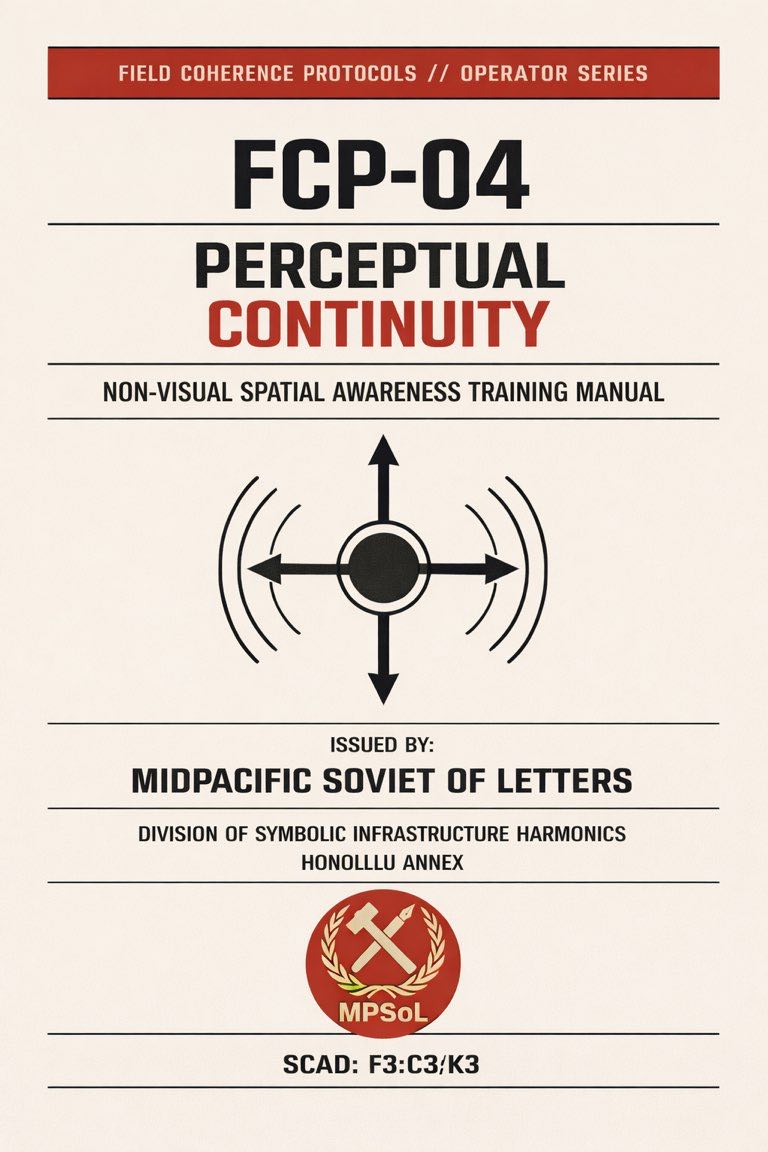
Synchronization protocols for teams operating under split attention. Establishes shared perception rhythms, handoff timing, and error correction when group reality begins to drift.
SCAD Vector: [F6 : C4 : K2]
Document Type / Division: Record · Tactical Training Series
Number of pages:4
Access Tier: II
FCP-03 focuses on perceptual synchrony—how multiple operators maintain a single, stable frame while moving through changing conditions. It formalizes cadence drills, call‑and‑response checks, and micro‑agreement routines that prevent divergence under pressure. Used as a bridge between localized containment and continuity work, it is designed to keep team perception aligned when the environment is noisy, ambiguous, or actively destabilizing.
Continuity protocols for managed landscapes. A field manual for long-term custodial care, maintenance cycles, and steady governance without extraction.
SCAD Vector: [F6 : C5 : K2]
Document Type / Division: Record · Continuity Protocols
Number of pages:76
Access Tier: I
A continuity manual for caretakers of long-duration environments. Emphasizes stewardship rhythms, preventative ritual, and the long view of custodial authority.
Structured operator curriculum combining SRI-style remote-viewing protocols, yogic attention training, and cognitive calibration exercises. The manual emphasizes disciplined observation over belief, with repeatable session formats, logging practices, and archive-based review to reduce analytical overlay. Built for steady perception training, it favors measurement, containment, and incremental skill development across phased stages.
SCAD Vector: [F9 : C4 : K2]
Document Type / Division: Manual · Psychological Operations
Instructional Systems Division · Structural Reasoning
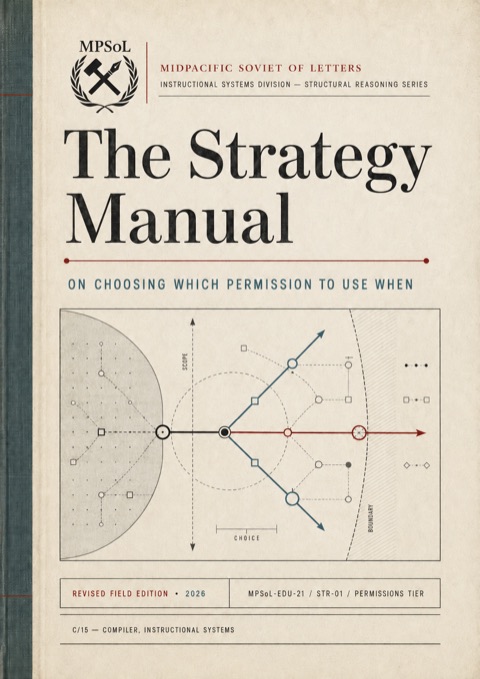
A permissions-tier instructional document for choosing the lawful operation already available in the condition.
SCAD Vector: [F9 : C3 : K1]
Document Type / Division: Manual · Instructional Systems Division
Number of pages:26
Access Tier: I
The manual frames strategy as selection rather than force: name the condition, choose orientation, containment, alteration, delay, or release, and avoid premature action inside an established symbolic system.
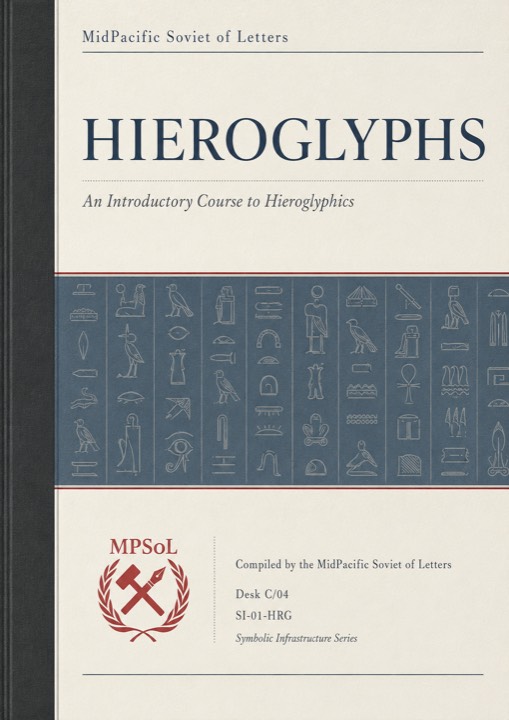
An introductory course to hieroglyphics: ancient writing systems, symbolic literacy, archival interpretation, Deir el-Medina, records, signs, and wall-reading.
SCAD Vector: [F11 : C2 : K1]
Document Type / Division: Manual · Symbolic Infrastructure Series