Restricted Project File / YBR-VT
Yellow Brick Road
The former classified file dump has been retired. This shelf now houses the Yellow Brick Road project.
The old key still applies.
Classified accesses (unique visitors): enter the old key to reveal the live count.
Cooperative Edition
The page below now carries the longform Yellow Brick Road dossier itself rather than the earlier project summary. It is arranged as a four-part file with a final notice and should be read as a request for corroboration, contradiction, and better materials.
Recovered and Reconstructed Visual Materials
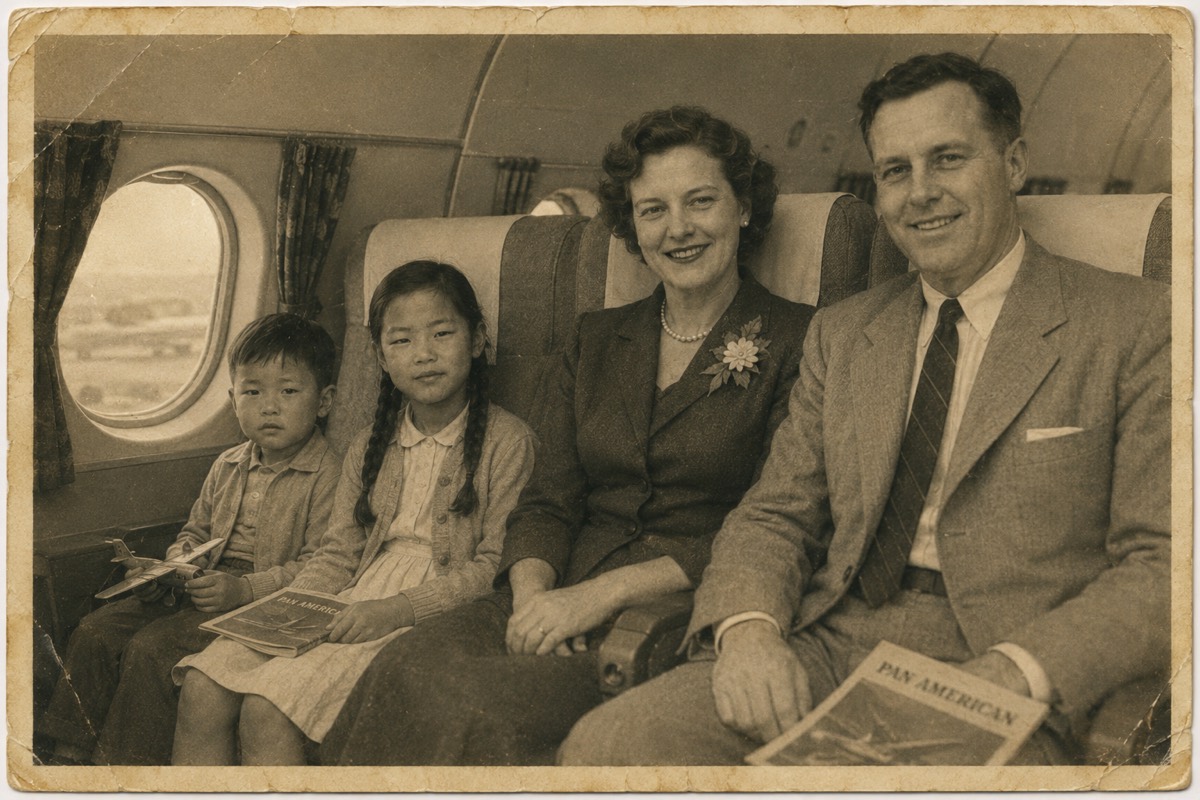
The following reconstructed images and associated fragment remain attached to the file as visual placeholders. They should be read under the cautions stated in the dossier, especially the final notice concerning loss, reconstruction, and damaged provenance.

PART I
THE CHILD ENTERS THE FILE
1952–1961
Cooperative Edition Note
The early Hwan-Jin “Van” Thomas materials are not sufficient for biography.
They consist of a damaged manila envelope, five photographs of uncertain sequence, several administrative fragments, one household address card, one church clipping of disputed relevance, and later notations made by unknown hands. These materials may concern the same child. They may concern the same household. They may not.
The Soviet has arranged them because arrangement is required for review. Arrangement should not be mistaken for proof.
Readers are asked to assist where the file cannot.
Family albums, church bulletins, school intake records, neighborhood photographs, adoption-adjacent paperwork, holiday home movies, local newspaper items, and private correspondence from Riverside between 1952 and 1961 may correct, enlarge, or invalidate this section.
The present file begins with a child.
It does not yet establish a life.
Section 1
Arrival Envelope
The first Hwan-Jin “Van” Thomas file is not a file in the formal sense.
It is a manila envelope containing five documents, two photographs, one address card, and a church bulletin clipping whose relevance was disputed during initial review. The envelope is marked:
THOMAS / RIVERSIDE / CHILDREN / 1952
A later hand has added:
VAN?
This edition preserves the question mark.
The materials do not establish a musician. They establish a transfer. Two Korean minors were received into a Riverside household in the summer of 1952. The female child appears more consistently in the record. Her name is rendered with minor variation across three documents. She faces the camera in both surviving photographs assigned to the folder. In each, she stands close to the male child.
The male child is smaller, less legible, and appears to have been renamed in stages.
No instrument is visible in the arrival photograph. No musical ability is noted in the placement summary, household card, church clipping, or readiness form. A later reader has underlined the word “hearing” on the readiness form and added a marginal mark beside it. There is no evidence that the mark is contemporary.
For purposes of this edition, the male child is referred to as Hwan-Jin “Van” Thomas. The file does not establish whether “Van” began as a household convenience, a schoolroom abbreviation, or a preference later adopted by the subject himself. It establishes only that the shortened form became useful before it became stable.
The boy was not yet a prodigy. He was not yet a guitarist, arranger, teacher, session substitute, or disputed author. He was a child in transit, delivered into a brightness the camera could not manage.
In 1952, he seems only to have entered one.
Materials Presently Assigned
YBR-I-001
Manila envelope Marked THOMAS / RIVERSIDE / CHILDREN / 1952, with later pencil addition VAN?.
YBR-I-002
Placement summary Carbon copy, partial institutional header, two Korean minors placed with Riverside household. Names unstable.
YBR-I-003
Arrival photograph, probable Two children, adult figure partly cropped, luggage visible. Later pencil identification on reverse.
YBR-I-004
Sister identification note Reverse-side annotation rendering the female child’s name as Mina, Min-ah, or similar.
YBR-I-005
Household address card Typed card identifying receiving household as Thomas, Riverside, California. Address incomplete.
YBR-I-006
Readiness form Institutional form noting language development, quiet temperament, and apparently acute hearing. Later underline not contemporary.
YBR-I-007
Church clipping Short notice welcoming or identifying the Thomas household. Religious significance unproven.
Section 2
First Christmas
The second Thomas image is the photograph most often reproduced from the early folder.
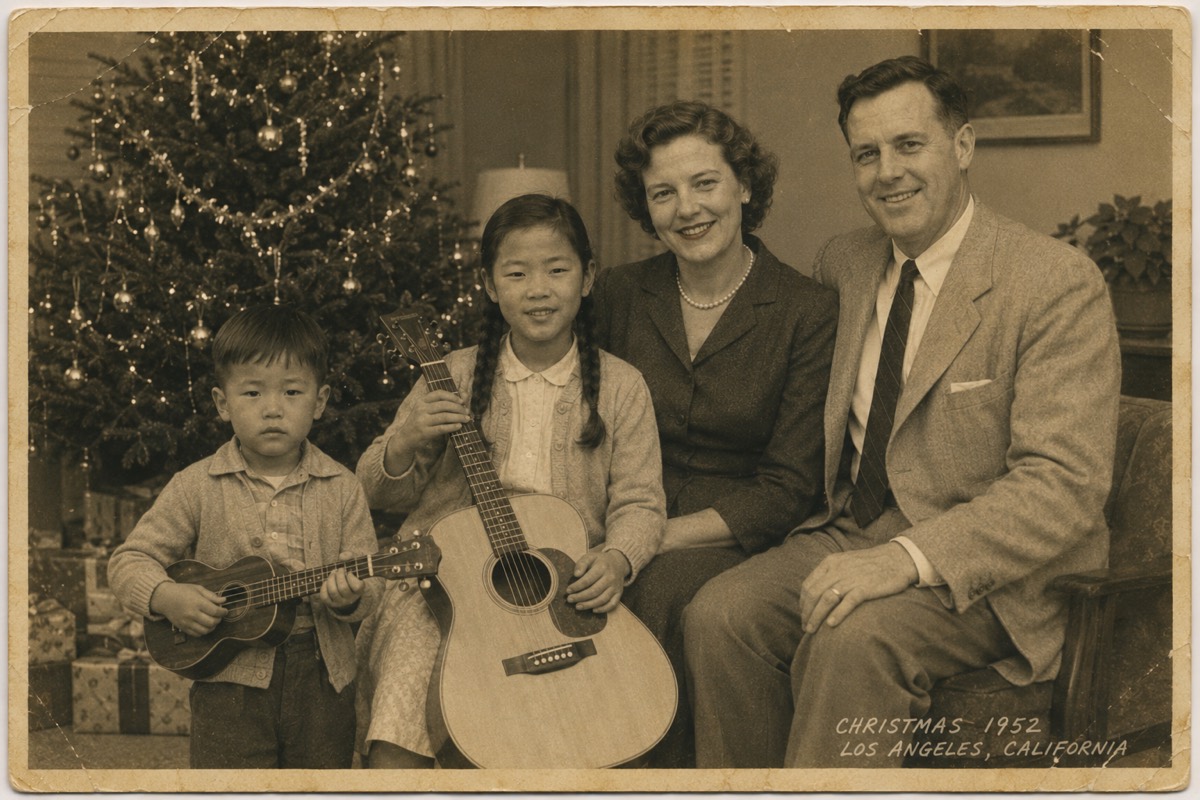
It is usually identified as Hwan-Jin “Van” Thomas’s first Christmas in Riverside. This is probable, though not established. The reverse annotation gives Xmas 1952, Van + Mina, and Riverside. The handwriting is later than the print. No original negative has been located.
The photograph shows a decorated tree, two children, and a small stringed instrument placed within reach of the male child. Previous summaries have described the object as a guitar. One catalogue card calls it a ukulele. The image is not clear enough to settle the matter.
It has become important since.
The female child, here identified provisionally as Mina, sits closer to the tree and appears to be looking toward the camera. Hwan-Jin is lower in the frame. His right hand rests near the instrument but not on it. No adult in the photograph is fully visible. A sleeve appears at the left margin. The window behind the group is overexposed.
There is no evidence that the child could play the instrument in December 1952. There is evidence that someone wanted the object preserved with the rest of the Thomas materials.
A gift tag marked To Van was found in the same envelope, but the tag is unattached and undated. A department store receipt records the purchase of a junior stringed instrument in the same month. The receipt does not name the recipient. The placement of these items beside the photograph may reflect original household arrangement, later family memory, or archive enthusiasm.
The present edition accepts the photograph as part of the early Thomas record.
It does not accept the photograph as origin.
The boy is in the room. The instrument is in the room. That is the available claim.
Materials Presently Assigned
YBR-I-008
Christmas interior photograph Decorated tree, two children, small stringed instrument. Date and identities supplied by later annotation.
YBR-I-009
Reverse-side annotation Xmas 1952 / Van + Mina / Riverside. Handwriting not contemporary with print.
YBR-I-010
Gift tag, unmatched Marked To Van. Not attached to object. No date.
YBR-I-011
Department store receipt Purchase of junior stringed instrument, December 1952. Recipient not named.
YBR-I-012
Domestic photograph, no instrument visible Interior scene, likely Riverside household. Child present. No musical object visible.
Editorial Note C/07
On Photographic Content and Photographic Context
A photograph is usually read first as content.
This is understandable. The content is available. A child stands near a tree. A small instrument rests against a chair. A window is overexposed. The viewer names these items and feels that some work has been done.
Usually, it has not.
Content is what the photograph permits us to identify. Context is what allows those identifications to matter. A guitar in a photograph is not yet a musical childhood. A child beside a guitar is not yet a prodigy.
Most readers are poor at context because context does not arrive as an object. It must be brought in from outside the frame: date, household, money, habit, witness, preservation, later annotation.
This is why photographs are dangerous in small archives. They appear to give generously while withholding most of what judgment requires.
The child is visible. The instrument is visible. The relationship between them is not.
Section 3
Name Stabilization
The name Hwan-Jin appears in only one early document with any confidence.
The shortened name Van appears later, first as annotation, then as household convenience, then as administrative fact. The transition is not recorded. No document in the early folder explains who chose the name, whether the child accepted it, or whether it replaced another form already in use.
This absence should not be repaired by assumption.
The Thomas file is unusually vulnerable to naming error. Later materials contain Hwan-Jin Thomas, Van Thomas, V. Thomas, Thomas, Van, and one doubtful reference to Thomas Van. These may all indicate the same person. They may also represent the ordinary confusion produced when a small life passes through offices not built to preserve it.
For purposes of this edition, Hwan-Jin “Van” Thomas is used as the working name.
The quotation marks are not decorative. They are a warning.
Materials Presently Assigned
YBR-I-013
Early name reference Administrative fragment containing probable original given name.
YBR-I-014
Pencil notation: VAN? Later addition to envelope. Earliest uncertain shortened form.
YBR-I-015
Household or school card Later early-period card using Van Thomas without explanation.
YBR-I-016
Variant-name index Soviet cross-reference sheet listing known name variations.
Section 4
Household and Church Fragments
The early folder contains one church clipping and two references to the Thomas household.
These items have produced more interpretation than they can support.
The clipping appears to concern a Riverside congregation and the Thomas family. It may indicate Baptist affiliation. It may indicate attendance. It may indicate nothing more than that a church community noticed the arrival of two children. The surviving text is too incomplete to determine whether the children participated in church life or were merely named in a welcome notice.
Later readers have attempted to connect this clipping to Van Thomas’s possible exposure to gospel music.
The present edition rejects that connection at this stage.
A household may be Baptist without producing a musician. A church may have a choir without shaping a child’s ear. A child may sit in a room where music occurs and remain, for the purposes of evidence, only a child in a room.
The clipping is retained because it may help local researchers identify the receiving community.
It is not retained as proof of musical formation.
Materials Presently Assigned
YBR-I-017
Church clipping, partial Riverside congregation reference. Possible Thomas household mention. Denomination uncertain in surviving portion.
YBR-I-018
Household address card Repeated here for cross-reference. May assist in church or neighborhood search.
YBR-I-019
Undated household note Possible reference to lessons or children’s activity. Attribution uncertain.
Section 5
Local Search Requested
The Soviet cannot complete Part I from the materials presently held.
Readers with access to Riverside-area materials from 1952–1961 are asked to search for references to Hwan-Jin Thomas, Van Thomas, the Thomas household, Korean adoptee or placement records, church welcome notices, school intake forms, Christmas photographs, children’s pageants, neighborhood gatherings, or domestic home movies.
Relevant materials may include:
- family photographs
- school records
- yearbooks
- church bulletins
- choir or Sunday school programs
- adoption-adjacent paperwork
- neighborhood newsletters
- local newspaper clippings
- home movies
- letters mentioning the Thomas children
- receipts for instruments or lessons
- marginal notes on photographs
- unidentified photographs of Korean children in Riverside households during the period
Readers are not asked to confirm the Soviet’s arrangement.
They are asked to improve it.
Contradictory materials are especially welcome. A photograph that disproves an identification is of greater value than a memory that flatters one. A receipt that moves a date is preferable to an anecdote that improves a myth.
The Thomas file is not protected by scarcity.
It is endangered by it.
Part I Reader Docket
At the close of Part I, the reader may believe the following:
Two Korean minors appear to have entered a Riverside household in 1952. The male child is provisionally identified as Hwan-Jin “Van” Thomas. The shortened name Van appears later and becomes administratively useful. A Christmas photograph shows a child near a small stringed instrument. A church-related clipping may connect the household to a Riverside congregation.
The reader may not yet believe the following:
That the child played the instrument. That the instrument belonged to him. That the household’s possible church affiliation shaped his musical development. That the Christmas photograph records an origin. That the early file is adequate.
The file is open.
PART II
THE BOY APPROACHES MUSIC
1961–1967
Cooperative Edition Note
The school-period Thomas materials are thinner than they appear.
They include one music-class notation, several name-stabilizing school records, one photograph of uncertain identity involving an Elvis Presley record sleeve, one damaged Baptist program fragment, and later testimony collected long after the period in question. None of these materials is sufficient to establish musical formation.
They do, however, establish a zone of inquiry.
By 1961, Hwan-Jin “Van” Thomas appears to have entered Riverside school records under the shortened name. By 1962 or 1963, at least one music instructor had noticed his pitch retention and his attention to the accompanist. Around the same period, Presley-related materials and church music fragments were preserved near the Thomas folder.
The Soviet has arranged these materials as Part II because they may indicate the edge of musical development. The reader is asked to assist in determining whether that edge exists.
The file requires school rosters, music-class records, yearbooks, church programs, choir photographs, youth-service bulletins, recital sheets, local newspaper notices, private recollections, and home recordings from Riverside between 1961 and 1967.
The present section does not prove that Van became a musician.
It asks where that proof might be hiding.
Section 6
The Presley Photograph
The first high-school-period item in the Thomas sequence is also the least cooperative.
It is a small black-and-white photograph, unevenly trimmed, showing an Asian male youth seated near a low table and holding an Elvis Presley record sleeve. The print was found in the same manila envelope as the arrival materials, the Christmas photograph, the household address card, and the early school documents. It is one of five photographs presently assigned to the first Thomas folder.
This placement is suggestive.
It is not provenance.
There is no inscription on the reverse. No date appears on the print. No other person in the frame has been identified. The household cannot be matched conclusively to the room shown in Section 2. The chair is different. The window treatment is different. The wall behind the subject is too bare to assist comparison.
The subject may be Hwan-Jin “Van” Thomas. The subject may be another boy of roughly the correct age, in roughly the correct period, holding a record later readers wished to be important.
C/07’s warning regarding photographic context is applicable in full.
The content is plain enough: boy, record sleeve, domestic room, probable early 1960s. The context is weak. The eye supplies what the file does not.
The photograph entered prior Thomas summaries as Van with Elvis record. One unsigned card, probably from the second cataloguing pass, expands this to Van with Elvis gospel LP. The expansion is not supported by the print. Presley’s face is visible. The album title is not.
A school library card from the same approximate period records a Van Thomas borrowing a juvenile biography of Presley. This is the first school record in which the shortened name appears without hesitation. The hand is administrative. The name is ordinary there.
That fact may matter more than the record.
By 1961, Hwan-Jin Thomas would have been old enough to enter the public-school machinery without the file needing to explain him. The intake anxiety of 1952 has disappeared. No document asks what name he answers to. No note identifies the sister as necessary to communication. No form marks him as newly arrived.
The record now says Van.
The Presley materials consist of the photograph, the library card, and a damaged magazine clipping showing Presley in performance dress. The clipping has no date and no visible source title. It was folded twice before entering the envelope. One fold crosses the face. Another crosses the guitar.
No musical claim can be drawn from these items.
It would be easy to arrange them into a story. Presley may have led Van toward gospel music. Gospel may have led him toward choir rooms. Choir rooms may have led him toward rock and roll.
The arrangement is attractive.
The evidence is too small.
The present edition retains the Presley photograph as an associated image only. It may show Hwan-Jin Thomas. It may show another boy. It may show the right record in the wrong hands.
No conclusion follows.
Materials Presently Assigned
YBR-II-001
Presley photograph, unprovenanced Asian male youth holding Elvis Presley record sleeve. No inscription. No date. Identity uncertain.
YBR-II-002
School library card Borrowing record for juvenile Presley biography. Name appears as Van Thomas.
YBR-II-003
Presley magazine clipping Damaged clipping. Source and date unknown. Fold marks through face and guitar.
YBR-II-004
Second-pass catalogue card Later card identifying photograph as Van with Elvis gospel LP. Title unsupported by image.
Section 7
Watches Accompanist
The first reliable musical note in the Thomas sequence is not a performance notice.
It is a teacher’s notation on a class sheet from the 1962–63 school year. The document is damaged along the upper right corner, but the relevant entry is legible:
Thomas, Van — good pitch retention. Soft voice. Watches accompanist.
The entry has been copied in three prior summaries. Two omit soft voice. One changes watches to studies. The present edition restores the original wording.
It is a better sentence without help.
Good pitch retention is a routine music-class observation. It may indicate unusual memory. It may indicate an ordinary student able to repeat a sung phrase. Soft voice records volume, not character.
Watches accompanist is less routine.
No claim is made here that Hwan-Jin Thomas understood harmony, arrangement, chord structure, or performance practice in 1962. The note supports only the teacher’s observation that Van’s attention moved toward the source of accompaniment.
This may have been musical interest. It may have been social avoidance. It may have been the common habit of a quiet student looking away from the class.
The file cannot decide.
A homeroom roster from the same year lists him as Van Thomas. No Korean given name appears. No correction is marked. By this point, the abbreviated name seems to have passed into ordinary school use. The documents do not explain the change. They simply behave as though the change has occurred.
A second item, probably from a school assembly or church-adjacent music program, includes a junior choir and an accompanist. No Thomas is listed among performers. The program was retained in the same folder as the music-class notation. Its relevance is archival before it is evidentiary.
One penciled exercise sheet has been proposed as an early Thomas music paper. The page contains staff lines, several note names, and what may be chord diagrams. The hand is juvenile. The attribution is weak. The page is included here only because it was filed between the roster and the music-class sheet during the second cataloguing pass.
Later testimony is more vivid and less dependable.
A classmate interviewed in 1998 recalled that Van watched the piano like it was giving instructions to everyone else. This may be memory. It may also be a later person improving the teacher’s note without knowing he had done so.
The phrase remains useful because it repeats the direction of attention.
At this stage, the Thomas file contains a student whose name has stabilized, whose voice was recorded as soft, whose pitch was good enough to note, and whose eyes, at least once, went to the accompanist.
That is the first musical fact with weight.
Small weight.
But weight.
Materials Presently Assigned
YBR-II-005
Music-class notation Teacher sheet, 1962–63. Entry reads: Thomas, Van — good pitch retention. Soft voice. Watches accompanist.
YBR-II-006
Homeroom roster Lists Thomas, Van. No Korean given name or correction mark.
YBR-II-007
School or community music program Damaged program showing junior choir and accompanist. No Thomas listed.
YBR-II-008
Pencil exercise sheet Staff lines, note names, possible chord diagrams. Attribution uncertain.
YBR-II-009
Later classmate testimony 1998 interview recalling Van’s attention to piano accompaniment.
Section 8
Baptist Paper, Unconfirmed
The Baptist fragment has been placed in Part II because it may describe the musical environment around Thomas during the school years.
It does not place him inside that environment.
The surviving paper appears to be a youth-service or music program from a Riverside-area Baptist congregation. The left edge is torn. The church name is incomplete. The remaining text includes Baptist, choir, and a Sunday evening time. A handwritten notation on the lower margin reads:
V.T.?
The mark is later.
No Thomas is listed among singers, ushers, musicians, readers, visitors, or youth participants. No address connects the program to the receiving household. No photograph accompanies it. The paper was preserved near the music-class notation and Presley materials, but preservation is not participation.
This point requires emphasis.
A Baptist church in Riverside may have had a choir. A Thomas household may have had some relation to a Baptist congregation. A boy named Van Thomas may have heard church music. None of these propositions proves the next.
The fragment is valuable because it may help readers search.
If the church can be identified, its bulletins, choir rosters, Sunday school records, youth programs, anniversary booklets, or photographs may supply context now missing from the Thomas file. They may show Van present. They may show his sister. They may show the Thomas household. They may show no connection at all.
All outcomes are useful.
The Soviet has retained the Baptist fragment as a directional object. It points toward a possible archive outside the archive.
It is not a witness.
Materials Presently Assigned
YBR-II-010
Baptist program fragment Damaged paper showing partial church/music language. Specific congregation unidentified.
YBR-II-011
Lower-margin notation Later handwritten V.T.? on program fragment. Hand unknown.
YBR-II-012
Church cross-reference sheet Soviet working list of Riverside Baptist congregations active during the relevant period.
Section 9
The First Guitar Claim
The first direct claim that Van Thomas played guitar does not come from the early photographs.
It comes from later memory.
A former schoolmate, interviewed in 2001, stated that Van had a guitar by ninth grade and could pick out Presley things after hearing them. The interview is useful, but it arrives late. It also contains two demonstrable errors concerning school year and teacher name.
The claim is therefore retained with caution.
No school instrument record presently confirms guitar instruction. No recital program lists him. No yearbook photograph has been located showing him with an instrument. No surviving teacher note describes guitar ability during the 1961–67 period.
The file contains only weaker items: the Christmas instrument photograph, the Presley photograph, the music-class notation, the pencil exercise sheet, and the late schoolmate interview.
These materials may belong to a single line.
They may also be separate dots mistaken for a line.
The present edition does not reject the possibility that Van Thomas played guitar during the school years. It rejects only the convenience with which the claim has been repeated.
Readers are asked to search for school performance programs, talent-show notices, yearbook club pages, music-room records, church youth programs, neighborhood band photographs, and private snapshots from Riverside between 1961 and 1967. A single photograph with reliable identification would alter the weight of this section.
A receipt for strings would help.
A lesson book would help more.
A home movie would help most.
Materials Presently Assigned
YBR-II-013
Late schoolmate interview 2001 testimony claiming Van had a guitar by ninth grade. Contains errors elsewhere.
YBR-II-014
Christmas instrument photograph, cross-reference See Part I. Instrument visible. Ownership and use unproven.
YBR-II-015
Pencil exercise sheet, cross-reference Possible student music paper. Attribution uncertain.
YBR-II-016
Unlocated yearbook reference Second-pass note mentions a possible yearbook image. No copy presently held.
Section 10
Local Search Requested
The Soviet cannot complete Part II from the materials presently held.
Readers with access to Riverside-area school, church, music, or family materials from 1961–1967 are asked to search for references to Hwan-Jin Thomas, Van Thomas, V. Thomas, Thomas Van, the Thomas household, Riverside school music programs, Baptist youth choirs, Elvis fan materials, early guitar instruction, and informal teenage performance.
Relevant materials may include:
- junior high or high school yearbooks
- homeroom rosters
- choir programs
- music-class records
- talent-show programs
- school assembly bulletins
- church youth-service programs
- Baptist choir rosters or photographs
- Sunday school newsletters
- family photographs
- home movies
- guitar lesson receipts
- instrument rental cards
- music-store receipts
- local newspaper youth features
- garage-band photographs
- private recollections from classmates, teachers, neighbors, or church members
Readers are not asked to protect the Thomas file.
They are asked to test it.
A document that shows the Presley photograph belongs to another family is useful. A church roster that contains no Thomas is useful. A yearbook page that corrects a date is useful. A photograph that confirms Van with a guitar is useful.
Correction is not damage.
Correction is the work.
Part II Reader Docket
At the close of Part II, the reader may believe the following:
The shortened name Van Thomas appears in school records by the early 1960s. A music instructor noted good pitch retention, soft voice, and attention to the accompanist. Presley-related materials were preserved near the Thomas file. A damaged Baptist program fragment may indicate a church-music search direction. Later testimony claims Van played guitar during the school years.
The reader may not yet believe the following:
That the Presley photograph shows Hwan-Jin Thomas. That Presley led Van toward gospel music. That Baptist choir exposure shaped his musical development. That the Christmas instrument became his instrument. That the school-period file proves musicianship.
The file remains open.
Readers with better evidence are requested.
PART III
THE YELLOW BRICK ROAD
1967–1983
Cooperative Edition Note
The career-period Thomas materials are more numerous than the childhood and school materials.
They are not more secure.
They consist of torn handbills, repair slips, cash envelopes, copied setlists, possible studio notes, unidentified band photographs, late interviews, and several references to performances that cannot presently be matched to venue records. These materials indicate work. They do not yet establish a career in the public sense.
This distinction matters.
A musician may work steadily and still fail to enter the record cleanly. A name may appear on weak paper, near amplifiers, near clubs, near money, near songs, and still never become legible to the institutions that later historians consult first.
The Soviet uses the term Yellow Brick Road to describe the condition suggested by the Thomas career file: a permitted path that resembles opportunity while returning the subject to the margin.
The term is not offered as decoration. It is offered as a working description of constraint.
Readers are asked to search for club calendars, flyers, setlists, union records, studio logs, photographs, tape boxes, newspaper entertainment listings, music-store receipts, private correspondence, home recordings, and interviews concerning Hwan-Jin “Van” Thomas, Van Thomas, V. Thomas, Thomas Van, and associated Riverside, San Bernardino, Inland Empire, or Los Angeles-area musicians active between 1967 and 1983.
The present section does not prove the legend.
It documents the difficulty of proving work that was never meant to be remembered.
Section 11
First Handbill
The first public musical placement of Van Thomas outside school records appears on a damaged handbill, probably late 1967 or early 1968.
The lower third is missing. The venue is not preserved. The date is incomplete. The surviving text reads:
FRIDAY NIGHT THE SUNSET W— with Van Thomas
No instrument is specified.
This is not enough to identify Thomas as a band member. The phrase with Van Thomas may indicate guest performer, substitute guitarist, featured local player, vocalist, friend of the group, or printer’s exaggeration. Small performances often advertised whoever could be made to sound like an event.
The document is retained because it places the name near public music.
It does not place the man securely inside a career.
A second handbill, held only as a photocopy, lists V. Thomas beneath three other names. The copy quality is poor. The original has not been located. Prior summaries describe this as a band roster. The present edition identifies it only as a printed association between V. Thomas and a performance notice.
The career file begins there: with a name attached to weak paper.
Weak paper is not nothing.
It is also not enough.
Materials Presently Assigned
YBR-III-001
First handbill, damaged Partial performance flyer. Reads THE SUNSET W— / with Van Thomas. Venue and lower text missing.
YBR-III-002
Photocopied handbill Lists V. Thomas beneath other names. Original not located. Function uncertain.
YBR-III-003
Second-pass catalogue card Identifies YBR-III-001 as first band flyer. Basis for description unknown.
Section 12
Amplifier Repair
The strongest early career-period document is an amplifier repair receipt.
It names Thomas, V., records work on an input jack and persistent hum, and notes payment in cash. The date is damaged, but the receipt appears to fall within the same period as the first handbill. The shop name is partially visible. The address may place it in Riverside or San Bernardino County.
This is not romantic evidence.
It is better than romantic evidence.
An amplifier repair receipt proves little about artistry. It proves contact with equipment, responsibility for maintenance, and a monetary transaction. It places Thomas near the ordinary burdens of working music: broken jacks, weak tremolo, hum, transport, repair, cash.
The Soviet gives this receipt more weight than several later interviews.
The interviews remember a man.
The receipt remembers a problem.
Problems are often better preserved.
A later receipt, probably from the mid-1970s, lists Van without surname and describes guitar amp, road wear. This item is included only as an associated document. The name is insufficient. The shop is plausible. The connection remains unproven.
Readers are asked to search music-store records, repair-shop receipts, warranty cards, pawn slips, and private ledgers from Riverside and the Inland Empire during this period.
A repair shop may remember what a newspaper did not.
Materials Presently Assigned
YBR-III-004
Amplifier repair receipt Thomas, V. Input jack, hum, cash payment. Date partially damaged.
YBR-III-005
Associated repair slip Lists Van, guitar amplifier, possible road damage. Surname absent.
YBR-III-006
Repair-shop cross-reference sheet Soviet list of possible Riverside / San Bernardino music shops requiring local confirmation.
Section 13
Cash Envelope
One small envelope in the Thomas career file is marked:
VAN — $18
No date appears. No venue appears. No event appears. The envelope contains no money.
Prior cataloguers treated the envelope as performance pay. This is possible. It is not established. The amount is plausible for a small local performance, rehearsal payout, private party, lesson settlement, equipment reimbursement, or debt unrelated to music.
The envelope is useful because it is small enough to resist mythology.
If it records music work, it records it at the level where most music work actually occurred: in cash, after hours, without receipt, and without institutional memory.
A second envelope reads guitar / 2 sets, but no name appears on it. It was found in a separate folder and added to the Thomas file during a later consolidation. Its inclusion is disputed.
The present edition retains both envelopes with caution.
Neither proves a career.
Together, they suggest the kind of evidence a career may leave when the career itself is not protected by contracts, credits, or reviews.
Readers are asked to search private band papers, family cash books, venue boxes, union cards, and personal collections for payment envelopes, handwritten payouts, or notes naming Van Thomas or V. Thomas.
Eighteen dollars may be more valuable than praise.
Praise travels.
Small money stays where it was put.
Materials Presently Assigned
YBR-III-007
Cash envelope Marked VAN — $18. No date or source.
YBR-III-008
Associated performance envelope Marked guitar / 2 sets. No name. Inclusion disputed.
YBR-III-009
Later catalogue note Identifies YBR-III-007 as club payout. Basis unknown.
Section 14
Caldwell Interview
The phrase Yellow Brick Road enters the Soviet arrangement through the Caldwell interview of 1998.
Caldwell is identified in the transcript as a working jazz guitarist and occasional bandleader in the Inland Empire. His dates, full name, and performance history remain insufficiently confirmed. He appears in two local entertainment listings from the early 1970s, but neither listing mentions Thomas.
The interview is late.
It is also central to the present edition.
Caldwell recalled speaking with Thomas after a mixed-bill performance in San Bernardino. The transcript gives 1971. Caldwell himself says maybe earlier. His statement is reproduced here because later file organization depends on it:
I told him, you’re on the Yellow Brick Road, my man. Goes nowhere. It ain’t your fault. Me, I’m lucky to Amos-and-Andy most nights. You? They don’t even have a picture for what they want you to be.
The sentence has been challenged as too neat.
It may be too neat.
Interviews conducted decades after disappointment should not be trusted merely because they sound true. Caldwell may have compressed several conversations into one. He may have improved his own memory. He may have supplied the phrase after learning that the Soviet had begun using it. He may also have said something close enough.
The usefulness of the statement does not depend entirely on its exactness.
Caldwell’s remark names a condition visible elsewhere in the career file. Thomas was not excluded from music. The documents do not support that. He appears near performances, equipment, payments, possible studio work, and later testimony. The difficulty was narrower.
There was no ready category for him.
Caldwell’s own bitterness is instructive. He does not describe racial legibility as freedom. He describes it as employment under condition. He could be asked to perform a picture already prepared by the room. Thomas appears to have faced a different problem. He could be technically useful, memorable, available, and still not fit the picture the room believed it had purchased.
This is the Yellow Brick Road as the Soviet uses the term.
A path may be offered. The path may be real. The destination may not be.
Readers are asked to search for Caldwell materials with the same seriousness as Thomas materials: band listings, photographs, interviews, musician-union references, club notices, private letters, recordings, or family recollections. If Caldwell cannot be established, the term must be weakened. If Caldwell can be established, the file changes.
The Soviet will accept either result.
Materials Presently Assigned
YBR-III-010
Caldwell interview transcript 1998 oral-history transcript. Identifies Caldwell as jazz guitarist / bandleader. Exact reliability unknown.
YBR-III-011
Local entertainment listings Two possible Caldwell performance references. No Thomas connection.
YBR-III-012
Soviet term sheet Internal note adopting Yellow Brick Road as analytic term for conditional inclusion and racial illegibility.
Section 15
Session Work, Uncredited
The most dangerous material in the Thomas career file concerns studio work.
A torn studio log fragment includes the notation:
V.T. guitar overdub take 3 usable no credit
The page is undated. The studio name is incomplete. The track title, if present, has been lost. No release has been matched to the fragment. No payment record confirms the session.
Prior cataloguers identified this as evidence that Thomas performed uncredited guitar work on a commercial recording. The present edition does not adopt that conclusion.
The notation may refer to Van Thomas. It may refer to another musician. It may refer to a working take that was never used. It may refer to a rehearsal, demo, advertisement, church recording, private pressing, or student session. The phrase no credit may be descriptive. It may also be an instruction.
This uncertainty is not incidental.
Uncredited work is difficult to prove because its condition is absence from the places proof is usually found. A musician who is not credited cannot be confirmed by looking only at credits. A studio that paid cash, reused tape, closed, moved, or discarded logs may leave only fragments. A session player may enter a recording without entering history.
The file therefore asks the reader to search laterally.
Collectors, engineers, families of engineers, defunct studios, garage labels, small-press records, church recording projects, demo reels, acetates, tape boxes, and musician estates may contain references that formal discographies omit.
A tape box marked V.T. would matter.
A studio invoice would matter more.
A recording with witness testimony would matter, but less than people think.
Sound alone is rarely provenance.
Materials Presently Assigned
YBR-III-013
Studio log fragment Partial notation: V.T. guitar overdub / take 3 usable / no credit. Date and studio uncertain.
YBR-III-014
Tape-box label, associated Unverified label containing VT and partial track title. Chain of custody weak.
YBR-III-015
Collector note Later note claiming Thomas contributed to uncredited regional recordings. No supporting documentation attached.
Section 16
Band Photograph, Probable
The clearest career-period photograph is not clear.
It shows four or five young men in a garage, driveway, or rehearsal room. Instruments are visible. One figure at left, holding or standing near a guitar, has been identified in later annotation as Van Thomas. The annotation is not contemporary with the print.
The photograph is useful.
It is not decisive.
The subject appears to be an Asian male of approximately the right age. The date range suggested by clothing, hair, amplifier style, and print stock is consistent with the late 1960s or early 1970s. No other figure has been identified. No band name appears. No location is written on the reverse.
The reader will want this to be Van.
The Soviet also wanted this.
The want is recorded here to prevent it from entering the caption.
Photographs of working bands often survive without names because the people in them did not know they were becoming evidence. A garage photograph was not made for the archive. It was made because someone had a camera and the band was assembled long enough to stand still.
If the photograph shows Thomas, it may be the best visual evidence of his performance years.
If it does not, it is still evidence of the kind of local scene in which the Thomas file asks to be searched.
Readers are asked to examine family albums, band photographs, school collections, neighborhood boxes, old frames, newspaper morgues, and home movies from Riverside, San Bernardino, Corona, Redlands, Pomona, and the wider Inland Empire.
The unidentified figures in this photograph may be easier to confirm than Thomas himself.
That would be enough.
A name beside him would change the file.
Materials Presently Assigned
YBR-III-016
Band photograph, probable Four or five musicians, garage or rehearsal setting. Later annotation identifies left figure as Van Thomas. Unconfirmed.
YBR-III-017
Reverse-side annotation Pencil notation: Van? and possible band name, mostly illegible.
YBR-III-018
Photographic comparison sheet Soviet working comparison between early photographs and band photograph. Not conclusive.
Section 17
Useful, Not Legible
The career file does not show a man excluded from music.
It shows a man insufficiently recorded by music.
This is a smaller claim and a stronger one.
Thomas appears near performance notices, repair receipts, possible payments, possible studio work, and at least one remembered conversation with another working musician. He appears often enough that absence from larger records becomes meaningful. He appears weakly enough that the absence cannot be made to confess.
The Yellow Brick Road should not be mistaken for ordinary failure.
Failure would be simpler.
The file suggests labor under limited permission. Thomas could enter rooms. He could play, repair, substitute, teach, arrange, or assist. He could be useful. Usefulness is documented more readily than recognition. The useful person is named on envelopes, not posters; on repair slips, not album jackets; in stories, not indices.
This is why reader assistance is required.
The missing Thomas materials, if they exist, are unlikely to be in the first places one would search for a famous musician. They are more likely to remain with people who did not know they had evidence: a drummer’s widow, a retired church secretary, a club owner’s son, a former student, a collector of local 45s, a cousin with unlabeled reels, a teacher who kept programs, a neighbor who filmed a backyard party.
The Soviet does not ask these persons to confirm the legend.
It asks them to check the box.
A false lead is acceptable. A contradiction is acceptable. A correction is acceptable. Silence is expected.
The Thomas career file remains provisional because provisional is the most honest condition available.
It proves work.
It does not yet prove the shape of the life that work made.
Section 18
Local Search Requested
The Soviet cannot complete Part III from the materials presently held.
Readers with access to Riverside, San Bernardino, Inland Empire, Los Angeles-edge, or regional music materials from 1967–1983 are asked to search for references to Hwan-Jin Thomas, Van Thomas, V. Thomas, Thomas Van, Caldwell, associated bands, mixed-bill performances, repair shops, small studios, uncredited sessions, and local club circuits.
Relevant materials may include:
- club flyers
- handbills
- newspaper entertainment listings
- band photographs
- rehearsal photographs
- home movies
- garage recordings
- rehearsal tapes
- cassette labels
- reel-to-reel boxes
- setlists
- lyric sheets
- chord charts
- repair receipts
- music-store ledgers
- pawn slips
- cash envelopes
- venue calendars
- studio logs
- engineer notebooks
- private press records
- small-label correspondence
- musician-union references
- interviews with local musicians
- letters mentioning Van, V. Thomas, or “the Riverside guitarist”
- photographs of unidentified Asian guitarists in Inland Empire bands during the period
Readers are not asked to complete the Soviet’s argument.
They are asked to supply, damage, redirect, or refuse it.
The best submission may prove that a document presently assigned to Thomas belongs elsewhere. The second-best may establish that a name currently dismissed as coincidence is not coincidence. The third-best may be a receipt for a broken amplifier.
The archive will not improve without small evidence.
Small evidence is requested.
Part III Reader Docket
At the close of Part III, the reader may believe the following:
Van Thomas appears in career-period materials connected to local music work. At least one handbill places his name near public performance. At least one repair receipt connects Thomas, V. to musical equipment. A cash envelope may indicate small payment. The Caldwell interview provides the source or justification for the Soviet’s use of Yellow Brick Road. The career file suggests conditional inclusion rather than simple exclusion.
The reader may not yet believe the following:
That Van Thomas had a stable band career. That the band photograph certainly shows him. That the studio fragment proves commercial session work. That Caldwell’s quote is exact. That institutional racism alone explains every absence in the file. That the file proves hidden greatness.
The reader may believe something narrower:
A man worked near music. The record did not know how to keep him. The search must leave the archive.
PART IV
THE MAN LEFT NEAR MUSIC
1983–unknown
Cooperative Edition Note
The late Thomas materials do not record a retirement.
They record a change in paper.
After the early 1980s, Hwan-Jin “Van” Thomas appears less often in performance-adjacent material and more often in instructional material: lesson receipts, student notebooks, local music-school references, repair slips, and later testimony from persons who describe him as a teacher.
These materials are steadier than the career file.
They are not complete.
The Soviet has not located a formal retirement notice, full employment record, obituary, death certificate, final interview, complete student roster, or verified late photograph. Several items in this part depend on former student attribution. Several more depend on the assumption that Van Thomas, V. Thomas, and Thomas refer to the same person across late-period music documents.
The present section therefore asks readers to search living memory as well as stored paper.
Former students, parents of students, local teachers, repair-shop owners, conservatory staff, neighbors, family members, collectors, and Inland Empire musicians active after 1983 may hold the evidence this file lacks.
The late file does not ask whether Thomas became famous.
It asks what continuance leaves behind when fame is not the method of preservation.
Section 19
Conservatory Roster
The first stable late-period placement of Van Thomas appears in a local music-school brochure.
The document is a photocopy. The original has not been located. The lower margin is cropped. The relevant line reads:
Thomas, Van — guitar / theory / ensemble coaching
No biography is attached. No photograph appears. No dates of employment are given.
This is a modest document.
It is also one of the cleanest in the late file.
Unlike the handbills and cash envelopes of the career period, the roster identifies a role. Thomas is not merely with a band, near a repair, or named on uncertain paper. He is listed as an instructor. The shortened name appears without hesitation. The work is musical and institutional.
The document does not establish when he began teaching. It does not establish whether teaching replaced performance, supplemented it, or formalized work he had already been doing privately. It does not establish the size of his student base or the seriousness with which the institution regarded him.
It establishes presence.
That is enough for this section.
Readers are asked to search local conservatory brochures, private music-school advertisements, community college extension catalogs, adult education bulletins, music-store lesson boards, newspaper classifieds, and telephone directory listings from 1983 onward.
A complete roster would matter.
A photograph beside the roster would matter more.
A student list, if responsibly held and shareable, would alter the file.
Materials Presently Assigned
YBR-IV-001
Conservatory / music-school roster Photocopied brochure listing Thomas, Van — guitar / theory / ensemble coaching. Original not located.
YBR-IV-002
Cropped lower margin Missing date and possible institutional address. Requires original copy.
YBR-IV-003
Local instruction cross-reference sheet Soviet working list of possible music schools, conservatories, stores, and teaching rooms requiring confirmation.
Section 20
Lesson Receipts
The lesson receipts are the strongest ordinary evidence in the late Thomas file.
They are not dramatic. They do not describe musical greatness. They do not name a stage, band, recording, or influence. They record payment for instruction.
Several carbon-copy receipts, probably from the late 1980s or early 1990s, bear the name V. Thomas or Van. The clearest reads:
Guitar lesson — paid V. Thomas cash
A second receipt adds what appears to be a student first name. That name is withheld in the present edition pending contact or confirmation. A third receipt is too damaged to read with confidence, but the signature mark resembles the others.
The receipts are useful because they do not try to be useful.
They were made to record a transaction. They may establish that Thomas taught guitar privately, accepted cash payment, and kept some form of lesson accounting. They do not establish teaching style, student number, reputation, or continuity.
A receipt book may still exist.
Readers are asked to search desk drawers, lesson folders, family files, instrument cases, old check registers, music-store envelopes, and student notebooks for receipts bearing the names Van Thomas, V. Thomas, or similar variants.
Small payment records are requested.
The file has learned to trust them.
Materials Presently Assigned
YBR-IV-004
Lesson receipt, clear Carbon-copy receipt reading Guitar lesson — paid / V. Thomas / cash. Date partially visible.
YBR-IV-005
Lesson receipt, student name withheld Similar receipt with possible student first name. Identification pending.
YBR-IV-006
Damaged receipt fragment Signature mark resembles other late receipts. Attribution uncertain.
Section 21
Student Notes
The late Thomas file contains three student notebook pages attributed to Van Thomas’s instruction.
None is signed by him.
This is a problem.
The pages were donated with testimony from two former students and one family member of a former student. The pages contain chord diagrams, position markings, short technical corrections, and several instructions written in the margin. The most cited note reads:
Do not press harder. Listen first.
Prior summaries treated this as a Thomas teaching maxim. The present edition treats it as attributed instruction.
The difference is important.
A teacher’s phrase can survive by repetition long after its first wording disappears. A student may copy a correction in the teacher’s language. A later donor may remember the voice correctly but misdate the paper. Another instructor may have written the line. The page may be exactly what it appears to be.
The file cannot decide from the page alone.
The student notes are retained because they offer a possible entrance into Thomas’s late method. They suggest quietness, hand position, attention, and reduction. They also agree with later testimony describing him as a teacher who asked students to listen before increasing volume.
Agreement is useful.
It is not proof.
Readers are asked to search student notebooks, lesson books, chord sheets, photocopied exercises, annotated song pages, marginal corrections, and cassette lesson tapes from former Thomas students.
A signed page would matter.
A dated page would matter.
A page remembered by two independent students would matter differently.
Materials Presently Assigned
YBR-IV-007
Student notebook page A Chord diagrams and marginal instruction: Do not press harder. Listen first. Attributed to Thomas instruction.
YBR-IV-008
Student notebook page B Position markings, right-hand corrections, no signature.
YBR-IV-009
Student notebook page C Photocopied exercise sheet, possibly from group lesson or ensemble coaching.
YBR-IV-010
Donor testimony notes Two former students and one family member connect the pages to Thomas. Dates require confirmation.
Section 22
Former Students
The strongest late testimony comes from former students.
This is expected.
Teachers are often preserved by those who learned from them, not by the institutions that paid them poorly or listed them briefly. The Thomas file contains three late interviews conducted between 1996 and 2004. All three describe a man who continued to work near music after the performance years. None provides a complete biography.
One former student stated:
He never talked about bands unless you asked twice.
A second remembered:
He made me play quieter until I could hear the chord.
A third said:
He did not like the word talent. He said attention was less trouble.
The statements are useful. They are also late, affectionate, and vulnerable to improvement.
Late testimony tends toward shape. Former students remember a teacher as a figure. They compress repeated lessons into a sentence. They protect the person who once corrected them. This does not make them unreliable in the ordinary sense. It makes them human witnesses.
The file needs more of them.
Readers who studied with Van Thomas, knew someone who did, paid for lessons, attended student recitals, worked beside him, repaired equipment for him, or saw him teach are asked to submit testimony with dates, locations, names of other witnesses, and any surviving material objects.
A story is welcome.
A story with a receipt is better.
A story with another person who remembers the same room is better still.
Materials Presently Assigned
YBR-IV-011
Student interview A 1996 interview. Mentions reluctance to discuss earlier bands.
YBR-IV-012
Student interview B 2001 interview. Describes quiet playing and chord listening.
YBR-IV-013
Student interview C 2004 interview. Mentions Thomas’s dislike of the word talent.
YBR-IV-014
Interview reliability note C/14 caution regarding late affectionate testimony and repeated teaching phrases.
Section 23
Last Photograph, Probable
The late photograph should not be treated as a farewell.
It may not show Thomas.
The image was donated by a former student and is said to show Van Thomas in a music classroom, repair room, or store lesson space. The date is unknown. The subject is an older Asian man, partly turned away from the camera. Several guitar cases lean against the wall. A music stand is visible. The lighting is poor.
The donor identified the man as Van Thomas.
No independent confirmation has been found.
C/07’s warning regarding photographs remains applicable. The photograph has content: older man, music room, guitar cases, poor light. Its context depends almost entirely on donor identification. The image is moving because the file has trained the reader to want a late face. That desire should be recorded before it becomes evidence.
The photograph is retained as probable.
It is not conclusive.
Readers are asked to search photographs from student recitals, music-store lesson rooms, conservatory events, private lessons, repair counters, community performances, and family gatherings where music instruction occurred.
The late Thomas may appear at the edge of another person’s milestone.
A child’s recital photograph may contain him. A music-store anniversary board may contain him. A home movie of a lesson may contain his hand and not his face.
Partial evidence is welcome.
Identification requires care.
Materials Presently Assigned
YBR-IV-015
Late photograph, probable Older Asian man in music room or repair space. Donor identifies subject as Van Thomas. Not independently verified.
YBR-IV-016
Donor note Former student attribution. Date uncertain.
YBR-IV-017
Photographic comparison sheet, late Soviet comparison with earlier possible Thomas images. Inconclusive.
Section 24
Collector Correspondence
The Thomas afterlife enters the file through collectors before it enters any public history.
A short correspondence from the late 1990s refers to a Van Thomas, Riverside guitarist and asks whether the Soviet holds material related to an unidentified tape. The correspondent appears to be a collector of regional recordings, private press records, and Inland Empire performance ephemera. The name is withheld pending confirmation.
The letter is not evidence of Thomas’s importance.
It is evidence that someone was looking.
A second note, possibly an email printout from the early 2000s, uses the phrase Yellow Brick Road problem in relation to Thomas. The phrase may have been adopted from Soviet terminology rather than independently preserved. The direction of influence is unclear.
Collector certainty is not archival certainty.
Collectors often preserve what institutions discard. They also develop private mythologies around gaps, matrix numbers, undocumented sessions, and local reputations. Their work can be invaluable. It can also become self-sealing.
The present edition retains the correspondence because it points toward missing materials outside the Soviet file: tapes, reels, local 45s, studio notes, musician lists, private interviews, and regional discographies.
Readers with collections of Inland Empire, Riverside, San Bernardino, garage, gospel, jazz, rock, private press, school, church, or studio recordings are asked to search for variants of Thomas’s name and for unidentified Asian guitarists, instructors, arrangers, or session players linked to the region.
The file does not require a masterpiece.
It requires labels, names, dates, and custody.
Materials Presently Assigned
YBR-IV-018
Collector letter Inquiry concerning Van Thomas, Riverside guitarist and unidentified tape. Sender pending confirmation.
YBR-IV-019
Email printout, associated Mentions Yellow Brick Road problem. Direction of terminology unclear.
YBR-IV-020
Regional recording cross-reference sheet Soviet list of possible small-label, private press, church, school, and studio sources.
Section 25
No Obituary Located
The Soviet has not located an obituary for Hwan-Jin “Van” Thomas.
Searches under Hwan-Jin Thomas, Van Thomas, V. Thomas, Thomas Van, and known variants have not produced a public notice that can be assigned with confidence. This does not establish that Thomas did not die. It does not establish that he left Riverside. It does not establish that he lived under another name.
It establishes the limit of the search presently conducted.
Small American lives often receive administrative closure unevenly. Obituaries may be omitted, privately circulated, published under unexpected names, placed in church bulletins, filed under family names, or lost behind paywalls, microfilm errors, funeral-home closures, and ordinary neglect.
Absence of an obituary is not mystery.
It is a research condition.
Readers are asked to search funeral-home records where available, church memorial bulletins, local newspaper archives, family notices, cemetery records, memorial cards, social notices, alumni pages, music-school newsletters, and private correspondence.
The file does not ask readers to declare Thomas dead.
It asks them to locate, if possible, the public or private notice by which his later life was marked.
No last sentence has been found.
The archive will not invent one.
Materials Presently Assigned
YBR-IV-021
Obituary search note Internal Soviet memo listing searched name variants and negative results.
YBR-IV-022
Variant-name list Cross-reference: Hwan-Jin Thomas, Van Thomas, V. Thomas, Thomas Van, related spellings.
YBR-IV-023
Unassigned obituary clipping Obituary for a V. Thomas located but not assignable. Retained separately.
Section 26
Local Search Requested
The Soviet cannot complete Part IV from the materials presently held.
Readers with access to Riverside, Inland Empire, music-school, teaching, family, church, funeral, collector, or private student materials from 1983 onward are asked to search for references to Hwan-Jin “Van” Thomas, Van Thomas, V. Thomas, Thomas Van, and associated teachers, students, repair shops, conservatories, lesson rooms, and local music communities.
Relevant materials may include:
- conservatory brochures
- music-school rosters
- community college extension catalogs
- adult education bulletins
- music-store lesson boards
- business cards
- lesson receipts
- student notebooks
- chord sheets
- annotated song pages
- private lesson tapes
- student recital programs
- recital photographs
- home movies
- repair receipts
- music-store ledgers
- former student testimony
- parent recollections
- letters mentioning lessons with Van Thomas
- photographs of unidentified Asian guitar instructors in Riverside or Inland Empire music spaces
- collector correspondence
- tape boxes
- local recording notes
- funeral notices
- church memorial bulletins
- obituary clippings
- cemetery records
- family memorial cards
Readers are not asked to honor the existing arrangement.
They are asked to test it.
A former student who says the notebook page belonged to another teacher is helping. A parent who confirms a lesson receipt is helping. A collector who proves that V.T. on a tape box meant someone else is helping. A photograph that places Thomas in a room after 1983 is helping.
The late file is not weak because Thomas stopped mattering.
It is weak because teaching often leaves its evidence in private custody.
Private custody is now requested to speak.
Part IV Reader Docket
At the close of Part IV, the reader may believe the following:
Van Thomas appears in late materials connected to music instruction. A conservatory or music-school roster lists him for guitar, theory, and ensemble coaching. Lesson receipts suggest paid instruction. Former students remembered him as a teacher. A late photograph may show him in a music room. Collector correspondence shows later interest in the Thomas problem. No assignable obituary has been located.
The reader may not yet believe the following:
That Thomas formally retired from performance. That all late V. Thomas materials belong to Hwan-Jin Thomas. That the student notes are certainly in his hand. That the late photograph is confirmed. That no obituary exists. That the absence of public closure is itself evidence of disappearance.
The reader may believe something narrower:
The music continued at smaller scale. The public record thinned. The private record may still exist.
The file remains open.
Readers with better evidence are requested.
FINAL NOTICE
Concerning the Loss of the Thomas File
The reader should now be told what earlier sections withheld.
The Hwan-Jin “Van” Thomas file no longer exists in its original form.
The primary folder was destroyed during the Quonset hut flood of 2019. The loss included the manila envelope marked THOMAS / RIVERSIDE / CHILDREN / 1952, the five photographs assigned to the early folder, the school fragments, the Presley photograph, the Baptist program remnant, two repair receipts, one cash envelope, the Caldwell transcript, late student notes, and the unverified collector correspondence.
Several items had been scanned.
Most had not.
Several had been described.
Too many had only been remembered.
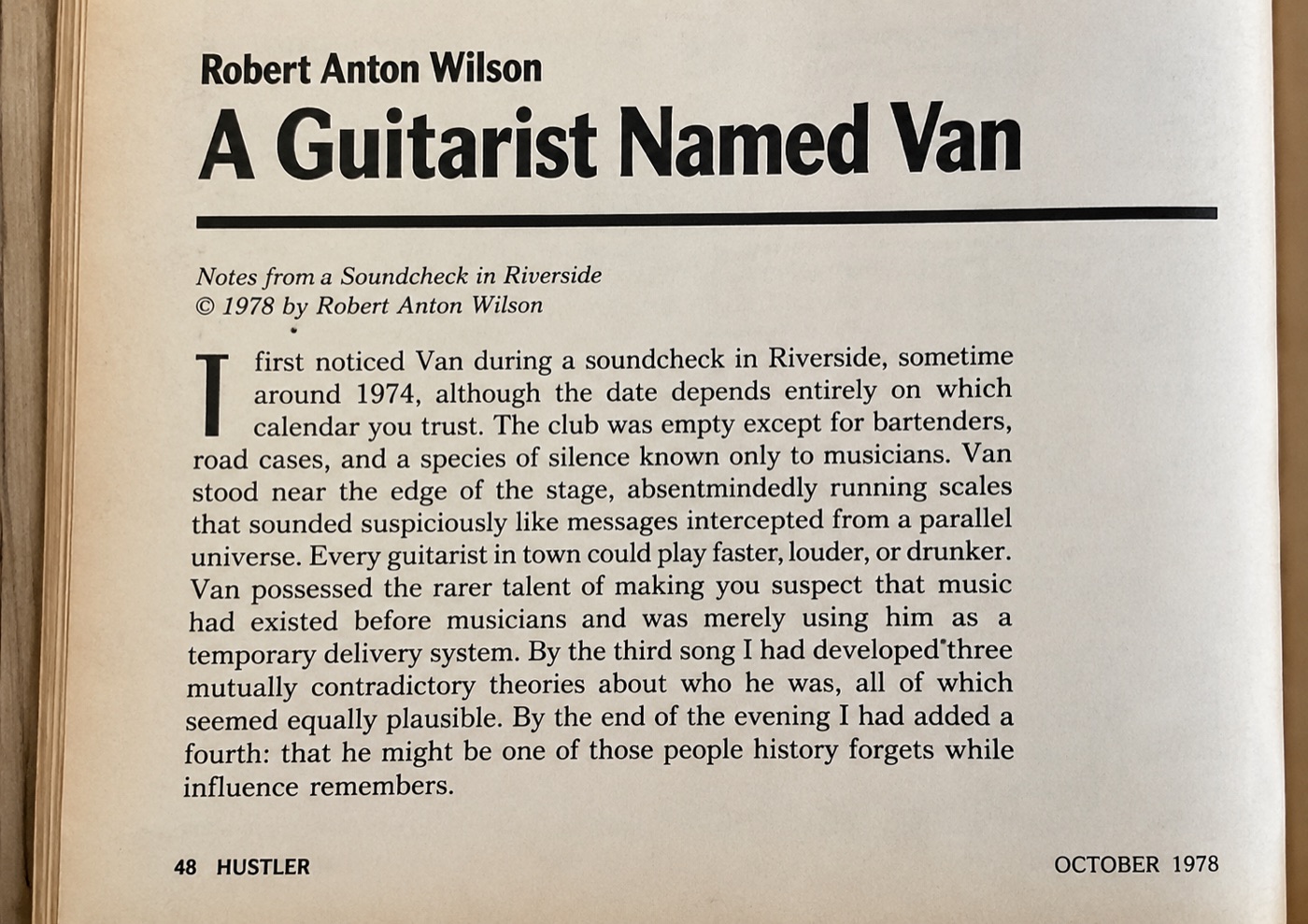
The present edition has therefore relied on secondary summaries, catalogue notes, damaged inventories, caption drafts, partial transcriptions, and regenerated representational images prepared from surviving descriptions. The photographs reproduced in this edition should not be treated as original documentary images. They are visual reconstructions of lost objects. The interviews and articles quoted herein have been restored from partial notes where possible and regenerated where necessary to preserve the shape of the file.
This is not ideal.
It is also not concealment. It is the condition under which the edition became necessary.
The Soviet does not possess enough original material to prove Hwan-Jin “Van” Thomas. It may not possess enough material to disprove him. What it possesses is the outline of a loss: names, dates, possible photographs, possible witnesses, possible rooms, possible music, and a recurring pattern of marginal presence.
For that reason, this edition is not the publication of a completed archive.
It is a request for one.
Readers are asked to search.
Search family albums, school boxes, church basements, record collections, music-store files, defunct studio papers, garage reels, home movies, yearbooks, lesson books, funeral cards, and the unmarked envelopes kept because someone once thought they might matter.
We are seeking original or corroborating materials related to:
Hwan-Jin Thomas. Van Thomas. V. Thomas. Thomas Van. An Asian guitarist, teacher, arranger, student, substitute, or repair customer active in Riverside, San Bernardino, or the Inland Empire between 1952 and 1985. A musician described in relation to the Yellow Brick Road. A jazz guitarist or bandleader named Caldwell. Unidentified photographs of local bands, choir rooms, music classrooms, home performances, or rehearsal spaces where such a person may appear.
We are especially seeking:
photographs, receipts, flyers, setlists, programs, home movies, interview recordings, tape boxes, school rosters, choir bulletins, church notices, repair slips, music-store ledgers, lesson receipts, student notebooks, obituary notices, and private recollections with dates and locations attached.
Contradictory evidence is welcome.
A correction is welcome.
A document proving that one of our reconstructed images is wrong is welcome.
A witness who says, “That was not Van Thomas,” is welcome.
The present edition has not been prepared to protect a legend. It has been prepared because the surviving legend is no longer safe from its own usefulness.
The Quonset hut took the file.
The file had already failed the man.
We are asking now for whatever escaped both failures.
Please check your boxes.
Submission Note
Please include identifying information, acquisition context, known chain of custody, and any uncertainty attached to the material. Uncertainty is useful when it is labeled.
Email intake is active. Send materials or preliminary inquiries to Norman.Rules@proton.me and include YBR-VT in the subject line or cover note.
C/14 - Symbolic Infrastructure Harmonics Division, MidPacific Soviet of Letters.