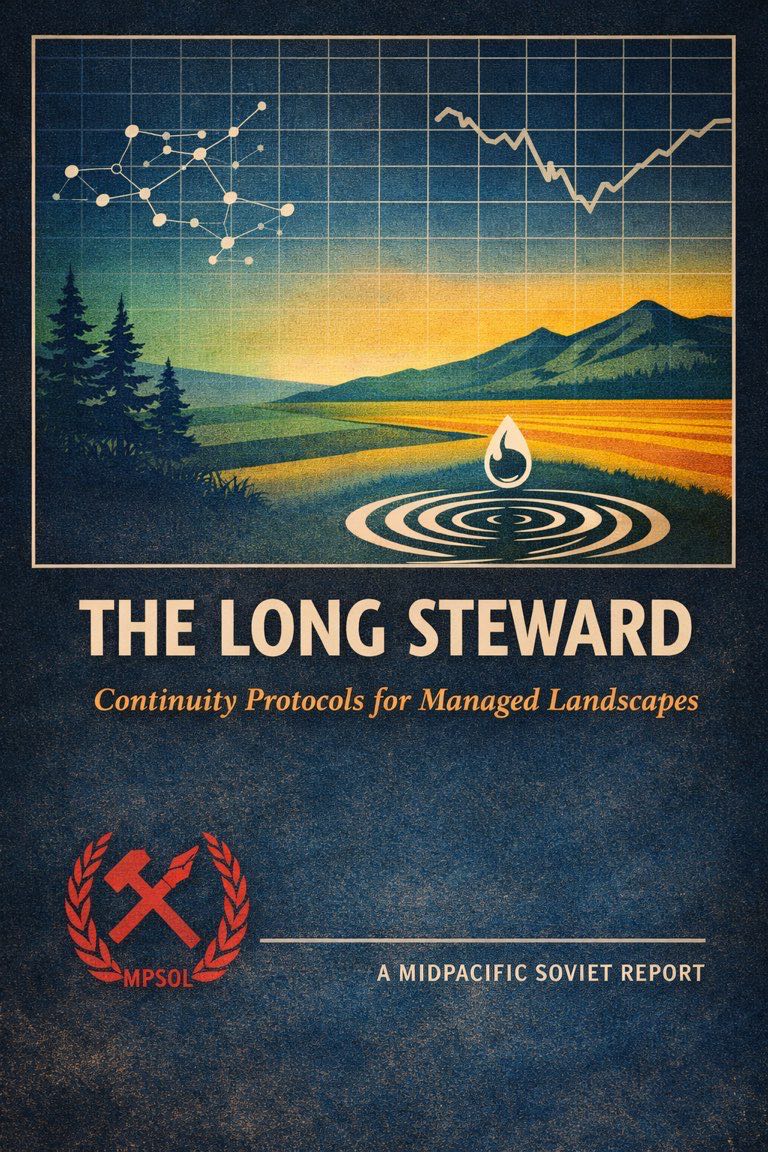
THE LONG STEWARD
Continuity Protocols for Managed Landscapes
Field Manual
MidPacific Soviet of Letters
Most landscapes described as "wild" were once maintained.
The maintenance was light.
Recurrent.
Distributed.
Because it left no monuments, it is often mistaken for absence.
The Long Steward documents what remains of those practices.
What This Manual Is
A field guide for continuity under incomplete conditions.
It does not restore lost worlds.
It does not optimize yield.
It does not promise regeneration.
It teaches interval.
Core Principle
Do not optimize for yield.
Optimize for persistence.
Small actions.
Long spacing.
Return without spectacle.
The manual assumes damage has already occurred.
Its purpose is not restoration, but continuity of method.
What You Will Learn
Protocols arranged by interval rather than task:
- Time as primary material
- Fire as compression tool
- Water as permission, not supply
- Trees as stored duration
- Understory as early signal
- Animals as moving measurements
- Edges as exchange zones
- Teaching without authority
- Loss as structural correction
- Leaving as final test
Each protocol emphasizes restraint over intensity.
Tone
Procedural.
Minimal.
Non-heroic.
Where conditions differ, allow the place to override the sequence.
Where certainty is high, reduce action by half.
Errors made slowly preserve more information than errors made quickly.
For Whom
- Land stewards
- Ecologists
- Foresters
- Regenerative practitioners
- Anyone responsible for land that will outlive them
If you are looking for rapid transformation, this is not that.
If you are willing to work in decades, this manual will feel familiar.
Archival Status
Creative Commons Attribution-NonCommercial-ShareAlike 4.0
Post-Victory Distribution
No claim of completion is made.
The manual is considered functional when it outlives its compiler.
Final Position
Time is the primary material.
All other materials respond to it.
Return.
Reduce.
Leave before you are necessary.