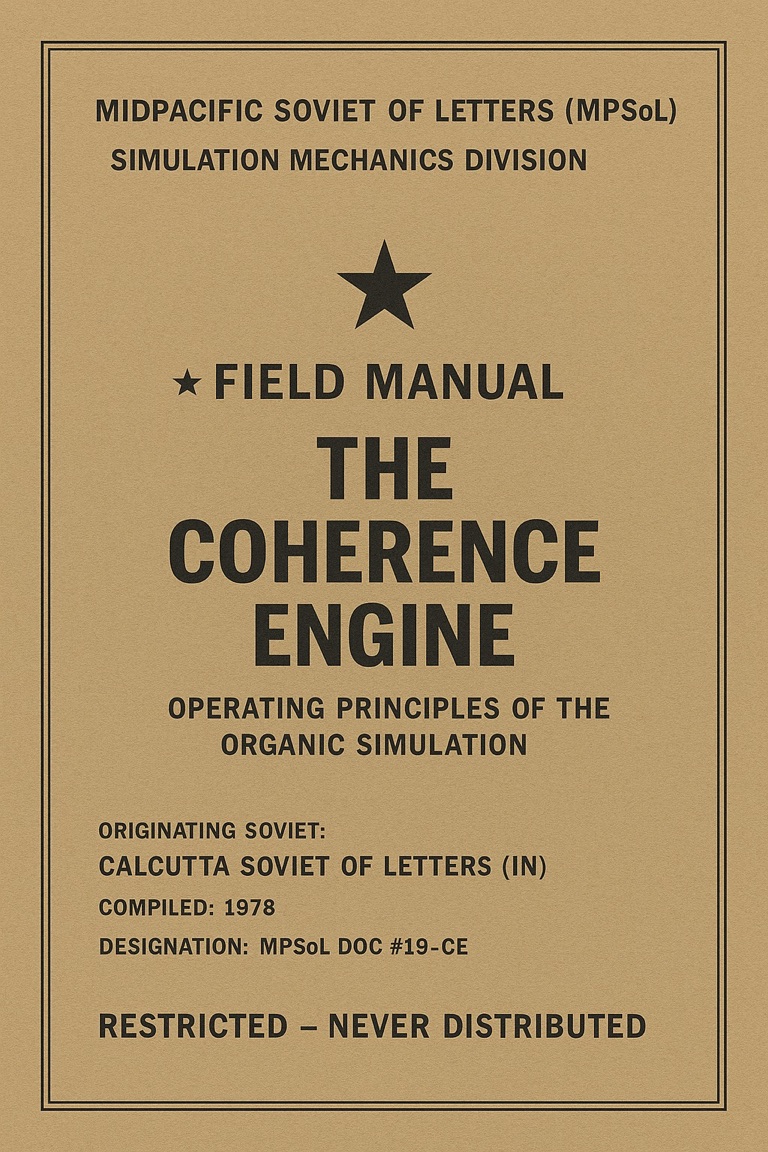
THE COHERENCE ENGINE
Archival Landing Note
MidPacific Soviet of Letters
Symbolic Infrastructure Harmonics Division
Filed as Public Record (1988)
The document defines "coherence" not as truth, virtue, or revelation, but as structural alignment: the integration of symbols, narrative, memory, and role such that experience presents as continuous and stable.
The "Engine" is not a device. It is a descriptive placeholder for distributed processes that stabilize perception across individuals, institutions, and cultures.
Several core claims anchor the text:
- Coherence is produced by integration, not accuracy.
- Belief is not required; enactment is sufficient.
- Narrative functions as compression, not explanation.
- Repetition and formalism are load-bearing infrastructure.
- Collapse is not purification, but load shedding.
The manual's most consequential contribution is its threshold model: coherence increases stability up to a point. Beyond that point, over-integration produces brittleness, identity compression, narrative lock-in, and eventual collapse.
Instability is not mystical. It is structural excess.
Notably, Section V refuses generative techniques. The clerical posture is conservative: observe without feeding, bracket time, preserve redundancy, delay action under high intensity. Stabilization is restraint, not amplification.
Within the broader MPSoL corpus, The Coherence Engine serves as theoretical backbone. Where other texts dramatize symbolic warfare or soul-house persistence, this document articulates the mechanics of stability itself. It is less poetic than canonical siblings, but more foundational.
Status: Canonical
Classification: Open Cultural Medium
License: CC BY-NC-SA 4.0
Function: Structural Theory / Symbolic Infrastructure Reference / Threshold Governance