THE COGNITIVE GEOMETRY TOOLKIT
Zagreb Armory Edition (1988-1990)
Recompiled by the MidPacific Soviet of Letters
MPSoL Archive PDF
There are documents that argue.
There are documents that persuade.
And there are documents that alter the shape of interpretation itself.
The Cognitive Geometry Toolkit belongs to the third category.
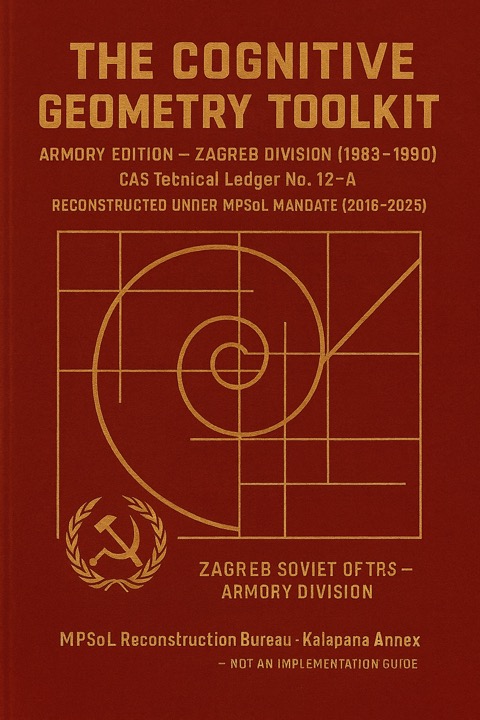
Recovered from the dissolved Zagreb Armory and reconstructed decades later by MPSoL, this manual does not focus on content, belief, or ideology. It studies structure - the hidden architectures that expand, compress, loop, accelerate, destabilize, or close interpretive space.
Zagreb's compilers believed something radical:
Geometry governs interpretation.
Interpretation does not govern geometry.
Surviving Taxonomy
This volume presents their surviving taxonomy - a classification of nine cognitive geometries:
- The Recursion Spiral
- The Field Lattice
- The Compression Engine
- The Instruction Cascade
- The Horizon Fold
- The Schism Layer
- The Latent Aperture
- The Harmonic Lattice
- The Collapse Engine
Each geometry is defined structurally, not philosophically. Each includes exposure effects, failure modes, interaction risks, and operator exit strategies.
This is not metaphor. It is analysis of form independent of meaning.
Important Scope Note
This is not an implementation guide. The applied protocols were lost during the 1990 closure.
What remains is taxonomy, reconstruction, and warning.
Engineers will recognize systems theory.
Writers will recognize narrative architecture.
Designers will recognize pattern logic.
Operators will recognize something older.
The Toolkit does not tell you what to think.
It shows you what structure is doing while you think.
Who This Is For
- Readers who suspect documents do more than state information
- Systems thinkers interested in structural cognition
- Writers curious about architecture beyond style
- Analysts studying persuasion without reducing it to psychology
- Anyone who has felt a text tighten, widen, accelerate, or collapse without knowing why
If you have ever finished a document and felt "closed" without understanding how it happened, this manual explains the mechanism.
What This Is Not
- Not a manifesto
- Not a theory of belief
- Not a metaphysical tract
- Not a persuasion manual
- Not a ritual system
It is a structural map of interpretive motion.
Why MPSoL Released It
The Zagreb Armory closed in 1990. Its implementation guides did not survive. What remains is record.
MPSoL's role in this edition is reconstructive, not adaptive. The text has been preserved with minimal intrusion - including its tensions, its contradictions, and its institutional voice.
We release it because architecture outlives institutions.
A Note to the Reader
This book may alter how you read.
Not what you read.
How.
If you find yourself noticing:
- Acceleration where there was none
- Narrowing that feels inevitable
- Boundaries that seem to shift
- Optional paths appearing mid-argument
- Documents that "land" with engineered quiet
...then the Toolkit is functioning as intended.
Read it slowly.
Step away when necessary.
Respect the Reframe.