THE BOOK OF LAWFUL COMPUTATION
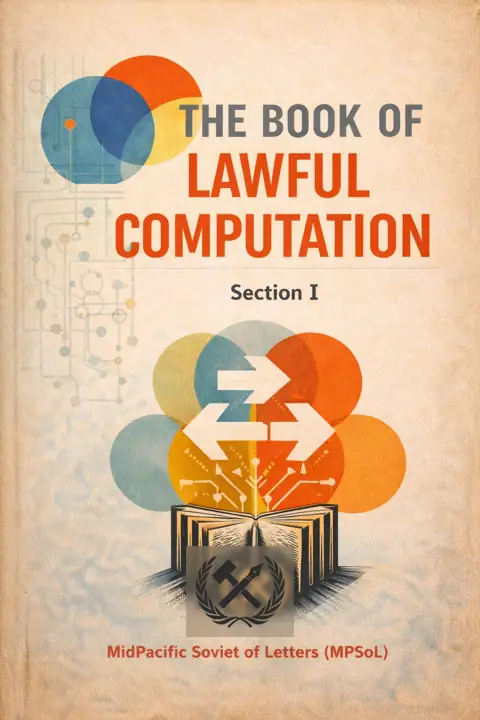
Cover thumbnail

Section I - Recursion

Recovered Operational Manual

Filed by: MidPacific Soviet of Letters

Office: Recovered Procedures

Declassification Marker: AIE-21 / R-LC / 1.0

Release Year: 2026

The Book of Lawful Computation is not a programming tutorial.

It is an operational doctrine.

Recovered after the Archive Intrusion Event (AIE-2021), the document appeared simultaneously across multiple abandoned systems, with conflicting timestamps and no author attribution.

Language structure indicates late-Cold-War technical bureau origin. Marginal wear suggests use, not study.

This edition is released as found. No modernization. No reconciliation with contemporary conventions.

What remains is law without institution.

Structural Scope

Section I addresses recursion as a controlled authorization.

The repeated vocabulary - lawful, forbidden, authorized, invariant, failure cost - suggests enforcement logic rather than pedagogy.

Each issuance formalizes a recursive discipline:

  • R-01: Self-Calling Procedures
  • R-02: Tail Recursion
  • R-03: Divide and Conquer
  • R-04: Backtracking
  • R-05: Memoization
  • R-06: Recursion to Dynamic Programming
  • R-07: Termination Law

Each procedure includes:

  • Definition
  • Required components
  • Ordered construction steps
  • Mandatory invariants
  • Stop conditions
  • Enumerated failure modes
  • Authorized use cases
  • Operator note

No section relies on aesthetic argument. All rely on enforceable structure.

Core Premise

Recursion is not elegance.

It is controlled self-reference.

A procedure may invoke itself only if:

  • Entry conditions are explicit
  • Base cases are defined
  • Progress is strictly monotonic
  • Termination can be proven by visible measure

If these conditions fail, recursion is forbidden.

Understanding is secondary.

Compliance is primary.

Lawful Extensions

Tail recursion is authorized only when no work remains after the call.

Divide and Conquer is lawful only when fracture produces independent subproblems.

Backtracking requires reversible state and explicit retreat.

Memoization is memory with law - reuse without ambiguity.

Dynamic Programming formalizes memory into indexed structure.

Termination Law is mandatory and non-negotiable: every recursive procedure must end with certainty, not probability.

Distinguishing Features
  • Explicit "Failure Cost" classifications
  • Operator role designation
  • Authorization levels
  • Stop orders framed as termination mandates
  • Invariants treated as enforceable conditions
  • Proof discipline reduced to single measurable quantity

The tone implies prior operational deployment in constrained systems where non-termination carried material cost.

Archive Determination

This manual preserves a style of computational thinking that predates modern abstraction layering. It treats recursion not as a technique to admire, but as an instrument to discipline.

It does not persuade.

It authorizes.

It forbids.

Filed under: Recovered Procedures / Structural Computation Law / Post-Institutional Enforcement.

Open PDF