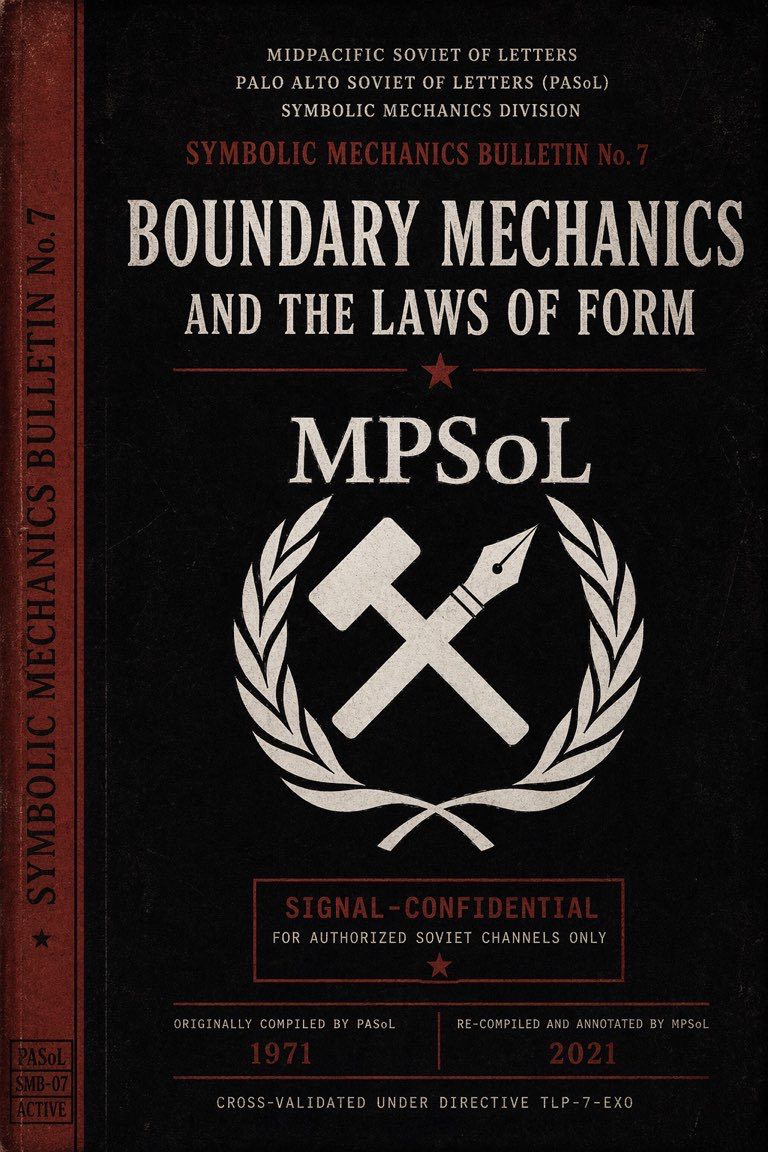
SYMBOLIC MECHANICS BULLETIN NO. 7
Boundary Mechanics and Laws of Form
PASoL (1971) • Re-Compiled by MPSoL (2021)
Signal-Confidential • Now Declassified
You are about to read a document that began as a containment measure.
In 1969, George Spencer-Brown published Laws of Form. Most readers saw mathematics. A few saw metaphysics. The Palo Alto Soviet saw something else:
A device.
Not a theory.
A device.
Bulletin No. 7 was drafted in 1971 because someone inside PASoL realized that drawing a distinction is not a neutral act. It is structural. It reorganizes reality at the level of observation.
To make a mark is to split the world.
That is not poetry. That is mechanics.
What This Bulletin Actually Does
- Explains the First Distinction without mystifying it
- Walks through the Laws of Calling and Crossing without turning them into slogans
- Formalizes re-entry and names the risks
- Integrates boundary mechanics into Simulation doctrine, cautiously
- Includes failure modes where paradox becomes operational risk
- Documents how to draw a line without collapsing the room
Why PASoL Intervened
Spencer-Brown's system is minimal - almost offensively so. One mark. Two laws. Everything else derived.
Minimal systems are powerful.
A boundary that can cancel itself.
A crossing that undoes itself.
A re-entry that models self-awareness.
Left uncontained, such elegance becomes mystical. Or unstable.
PASoL did what it always did:
It annotated.
It stabilized.
It made the mark administrative.
What You Will Find Inside
- An intelligence narrative of the 1969 incident
- Formal analysis of the mark and its calculus
- Re-entry and recursion explained without cult language
- Boundary mechanics in Simulation architecture
- Esoteric parallels acknowledged, not indulged
- Failure modes and signal leakage scenarios
- A practical operator's manual
- Field memoranda that are funnier than they should be
This is not a tribute volume.
It is a containment document that aged well.
A Word of Caution
Distinctions are not metaphors.
If you follow the logic carefully, you may notice that:
- Observer and observed are boundary effects
- Identity is an act of crossing
- Paradox is a boundary left unattended
Some readers find this exhilarating.
Some find it destabilizing.
Both reactions are predictable.
C/14's recommendation:
Read slowly.
Do not attempt to redraw yourself mid-chapter.
Archival Status
SMB-07
Originally Compiled: PASoL, 1971
Re-Compiled and Annotated: MPSoL, 2021
Classification: Formerly SIGNAL-CONFIDENTIAL
Current Status: Controlled Public Release
Filed under: Boundary Studies / Recursive Containment / Simulation Architecture
Creative Commons Attribution-NonCommercial-ShareAlike 4.0
Final Position
The mark is small.
The consequences are not.
Draw carefully.
Cross deliberately.
Do not linger in re-entry without a buffer.
"Let the mark be made. Let the crossing remain observed."