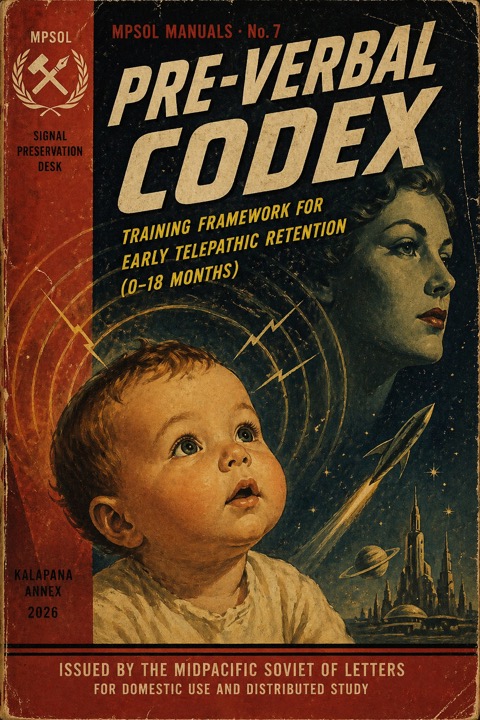
Pre-Verbal Codex
Training Framework for Early Telepathic Retention, 0-18 Months
Document Class: Field Manual, Domestic Application
Issuing Desk: CSAIT/18 - Signal Preservation Desk, Provisional
Division: Symbolic Infrastructure Harmonics Division
Release Authority: MidPacific Soviet of Letters
Edition: 1.0, Consolidated Draft
Date of Issue: 2026
Archive Status: Circulated for use; minor inconsistencies retained
Archive Notice
The Pre-Verbal Codex is a domestic field manual concerning the earliest period of human signal formation: the interval before language fully takes command.
Its premise is simple, difficult, and not presently resolved: that something active in early life may be diminished by ordinary development, especially as verbal language begins to organize perception.
The document does not claim to produce reliable telepathic ability. It does not claim clinical authority. It does not ask the caregiver to perform experiments on a child.
It asks for something narrower: careful attention, reduced interference, and the preservation of non-verbal channels before they are overwritten by instruction, correction, and naming.
Description
Issued by the Signal Preservation Desk, this manual provides a five-phase framework for caretakers working with infants from birth to eighteen months.
The phases proceed from basic receiver stabilization through signal recognition, directional intent, presence/absence bridging, and finally dual-channel development during the emergence of speech.
The method is intentionally low-pressure. No demonstrations are required. No testing is encouraged. No attempt is made to separate ordinary developmental behavior from more speculative forms of perception.
The manual repeatedly warns against over-interpretation, escalation, projection, and caregiver performance. In the view of the issuing desk, this restraint is not a weakness. It is the operating condition.
Phase Structure
Phase I - Receiver Stabilization, 0-3 Months
Establishes quiet, responsive conditions during feeding, holding, soothing, and ordinary presence. The emphasis is on trust, rhythm, affect clarity, and avoiding premature transmission attempts.
Phase II - Signal Recognition, 3-6 Months
Addresses early repeatable patterns: gaze, gesture precursors, movement, and emotional correspondence. The caretaker learns not to overwrite what is already forming.
Phase III - Direction and Intent, 6-9 Months
Introduces anticipation, pause, directional awareness, and silent intervals. The concern here is not accuracy, but the reduction of lag between intention and response.
Phase IV - Bridging Presence and Absence, 9-12 Months
Works with object permanence, absent caregivers, familiar locations, and gesture-image continuity. The infant begins moving through space as if continuity is assumed.
Phase V - Dual Channel, 12-18 Months
Addresses the rise of language and the risk of total symbolic dominance. The goal is not to resist speech, but to preserve gesture, silence, affect, and non-verbal perception alongside it.
Use Position
This is not a clinical document.
It is not a substitute for pediatric, developmental, or caregiving guidance.
It is not a guarantee of outcome.
It is a working framework for careful domestic application.
The practices are embedded in ordinary life: feeding, holding, play, transition, gesture, silence, and routine.
If the work begins to look like training, the document advises reduction. If the caretaker begins waiting for evidence, the condition has likely already degraded.
If you are trying too hard, you are no longer doing the work.
Why This Document Exists
Modern caregiving often assumes that development moves in one direction: toward speech, symbolic accuracy, correction, instruction, and measurable performance.
The Pre-Verbal Codex does not dispute that movement. It asks what may be lost during it.
Before language, the infant exists in a field of rhythm, affect, gaze, touch, anticipation, and shared regulation. The manual treats this field not as a sentimental mystery, but as a working environment.
Whether interpreted developmentally, symbolically, or non-locally, the practical instruction remains the same:
- Reduce noise.
- Do not force meaning.
- Do not convert every response into evidence.
- Do not let language arrive as a conqueror.
Recommended For
Caretakers, parents, symbolic educators, field observers, and readers of MPSoL materials concerned with early perception, signal preservation, domestic ritual, language formation, and non-verbal intelligence.
Also suitable for readers of:
- Containment Training for Signal Continuity
- The Book of Invisible Machines
- The GodSet Formula Atlas
- Field Coherence Protocols
- The Dreaming House
Archive Classification
Primary Tags: Infant Perception / Signal Preservation / Domestic Field Manual / Pre-Verbal Development / Non-Verbal Awareness / Caregiver Practice / Early Language Threshold
Secondary Tags: Telepathy / Affect Regulation / Gesture Retention / Receiver Stabilization / Object Permanence / Dual Channel Development / Symbolic Infrastructure Harmonics
SCAD Placement: F11:C2:K1
Archive Reentry / Low Charge / Domestic Containment
Compiler's Note
This document is among the quieter instruments in the archive. It does not announce itself as revelation. It does not promise powers. It does not ask the infant to become remarkable.
Its concern is more modest and therefore more difficult: to keep open a channel that most systems do not notice closing.
The child will learn words. The child will enter sequence, naming, correction, and instruction. The child will become legible.
The question preserved here is whether legibility must require the total loss of the earlier field. The Signal Preservation Desk has not resolved the matter. It has only retained the procedure.