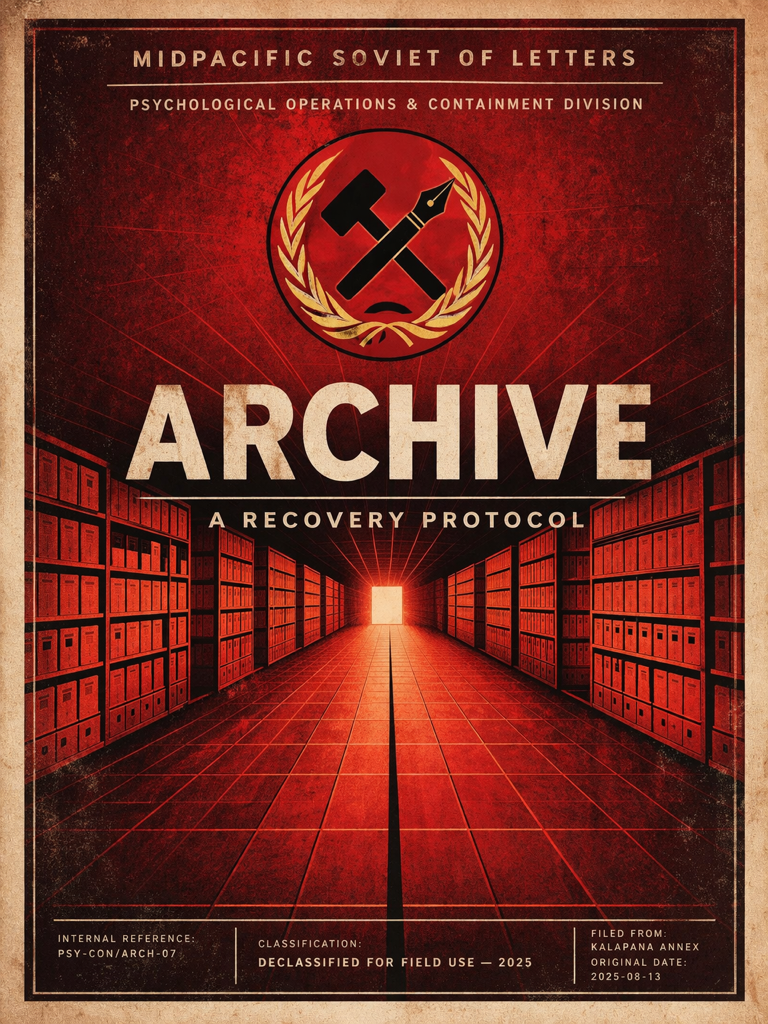
Archive

Cover thumbnail

MPSoL Archive PDF

ARCHIVE
A Recovery Protocol

Not Memory. Not Nostalgia.
Recovery.

Archive: A Recovery Protocol is a manual for stabilizing the self through structured recall.

It does not attempt to excavate trauma.

It does not promise catharsis.

It does not recommend confession.

It proposes that identity is stored in fragments - gestures, rooms, objects, phrases, unfinished scenes - and that deliberate reassembly can restore continuity without spectacle.

This is not memoir.

It is protocol.

The Core Idea

When personal narrative fractures, we compensate with abstraction.

The Archive proposes something simpler:

  • Collect the fragments.
  • Index them.
  • Handle them carefully.
  • Return them to circulation in small doses.

Recovery is not excavation.

Recovery is arrangement.

What This Manual Contains
  • Fragment retrieval exercises
  • Environmental memory mapping
  • Object-based recall procedures
  • Timeline reconstruction without dramatization
  • Containment techniques for destabilizing memory
  • Return-to-present calibration drills

The exercises are quiet.

There are no breakthrough moments promised.

There is only the gradual stabilization of continuity.

Why It Matters

We are overexposed to narrative therapy and underexposed to structural repair.

Archive treats the self as a system under strain.

Where some approaches seek emotional release, this manual seeks coherence.

It asks:

What if stability comes not from expression, but from ordering?

Tone and Method

The voice is restrained.

The method is incremental.

The posture is dignified.

There are no declarations of rebirth.

There is paperwork.

This is recovery as infrastructure.

Intended Reader

This document is for:

  • Those who feel fragmented but not broken
  • Those who distrust emotional spectacle
  • Those who prefer indexing to confession
  • Those who want steadiness, not drama

It assumes intelligence.

It assumes patience.

It assumes you are ready to work quietly.

Publication Notes

Filed under Recovery & Continuity Programs.

Released for general archive access following containment review.

Distributed under Creative Commons BY-NC-SA 4.0.

Open PDF