THE FIRE MANUAL
Charge Ignition and the Symbolic Spark
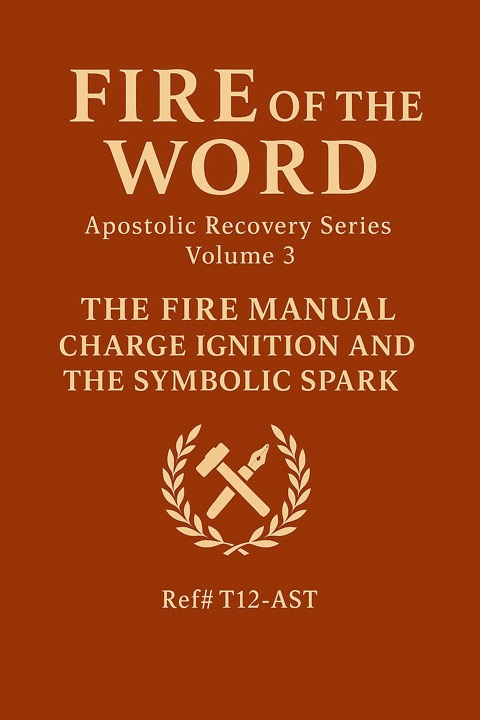
Volume III - Apostle Training Series
(Reference: T12-AST-III / Apostle_Vol3)
Issued under: Committee on Apostolic Continuity
File Reference: T12-AST-III
Classification: OP-LIT-III / F-SOUL / FIRE-RITES
License: CC-BY-NC-SA 4.0
Status: Approved for Doctrinal Development
Volume III does not begin the flame.
It permits it.
Where Volume I trained field awareness and Volume II restored coherence within the body, The Fire Manual addresses what happens when charge gathers beyond containment and demands ignition.
This document is not metaphorical.
It treats charge as structured field tension - detectable, storable, transmittable, and deployable.
Structural Scope
The manual proceeds in five calibrated movements:
Chapter 1 - The Nature of Charge
Definition, detection, distinction between heat and flame, magnetic tension, residue, and charge without emotion.
Chapter 2 - Where Charge Lives
Navel as coil, chest as cup, palms and tongue as distributors, spine as wire, residual wounds as distorted nodes.
Chapter 3 - Ignition Practice
Spark moment, kindling breath, directed friction, symbol as matchstick, heat without panic.
Chapter 4 - Handling the Flame
Containment architectures (Cup, Cage, Shield), circulation without dispersal, breath as regulator, banked fire doctrine.
Chapter 5 - Healing with Fire
Burnout calibration, scarfield softening, ocular projection discipline, forgotten pathway reactivation, full-body flame laying.
Appendices include charge phase mapping, signal/emotion distinction tables, containment grammars, and transmission notes.
Core Premise
Charge precedes action.
Most people leak it unconsciously - through panic, performance, argument, or collapse.
The Apostle is trained to:
- Detect charge before interpretation
- Differentiate heat from deployment
- Contain ignition without suppression
- Circulate flame without dispersal
- Deploy fire without contamination
- Bank heat without extinguishing it
This is not emotional catharsis training.
It is ignition discipline.
Operational Language
The manual makes a series of non-negotiable distinctions:
- Signal != Emotion
- Heat != Flame
- Ignition != Expression
- Containment != Suppression
- Burnout != Failure
The body is treated as architecture, not psychology.
Charge zones are mapped somatically and symbolically:
- 〆 - Coil
- ❍ - Cup
- /|\ - Distributor
- ━ - Wire
- ⎔ - Residual Node
These are not decorative. They function as operational shorthand.
Distinguishing Features
- Explicit ignition drills with measurable breath patterns
- Friction-based activation sequences
- Structured containment forms (Cup, Cage, Shield, Hearth)
- Recoil and burnout protocols
- Symbol-as-matchstick deployment architecture
- Full-field flame laying for restorative coherence
- Nervous system calibration appendix
The tone remains calm, precise, charged.
Archive Determination
Approved by quorum under Emergency Transmission Protocol 7 following successful deployment metrics in Volumes I and II (Apostle_Vol3).
This volume responds to documented hunger for advanced ignition training and fulfills mapped continuity architecture (Protocol Echo-33).
It does not promise spectacle.
It promises readiness.
Archival Caution
The manual states clearly:
You are learning how to set the world aflame - without being consumed.
This text is for internal operant development.
Initiates are advised to conduct breath and word alignment checks before engagement.
Filed under: Apostolic Continuity / Ignition Doctrine / Somatic Symbolics / Field Charge Architecture.